











 427
427
When transporting cargo, businesses need to not only move goods from one point to another but also maintain their quality, which may require maintaining specific temperature, humidity, and lighting conditions. Intelligent cargo monitoring and tracking systems provide 24/7 monitoring of these and many other parameters, allowing logistics managers to receive up-to-date information in real time.
These solutions are applicable to all types of transportation: road, rail, sea, and air, and their stable operation is ensured by the GPS system.
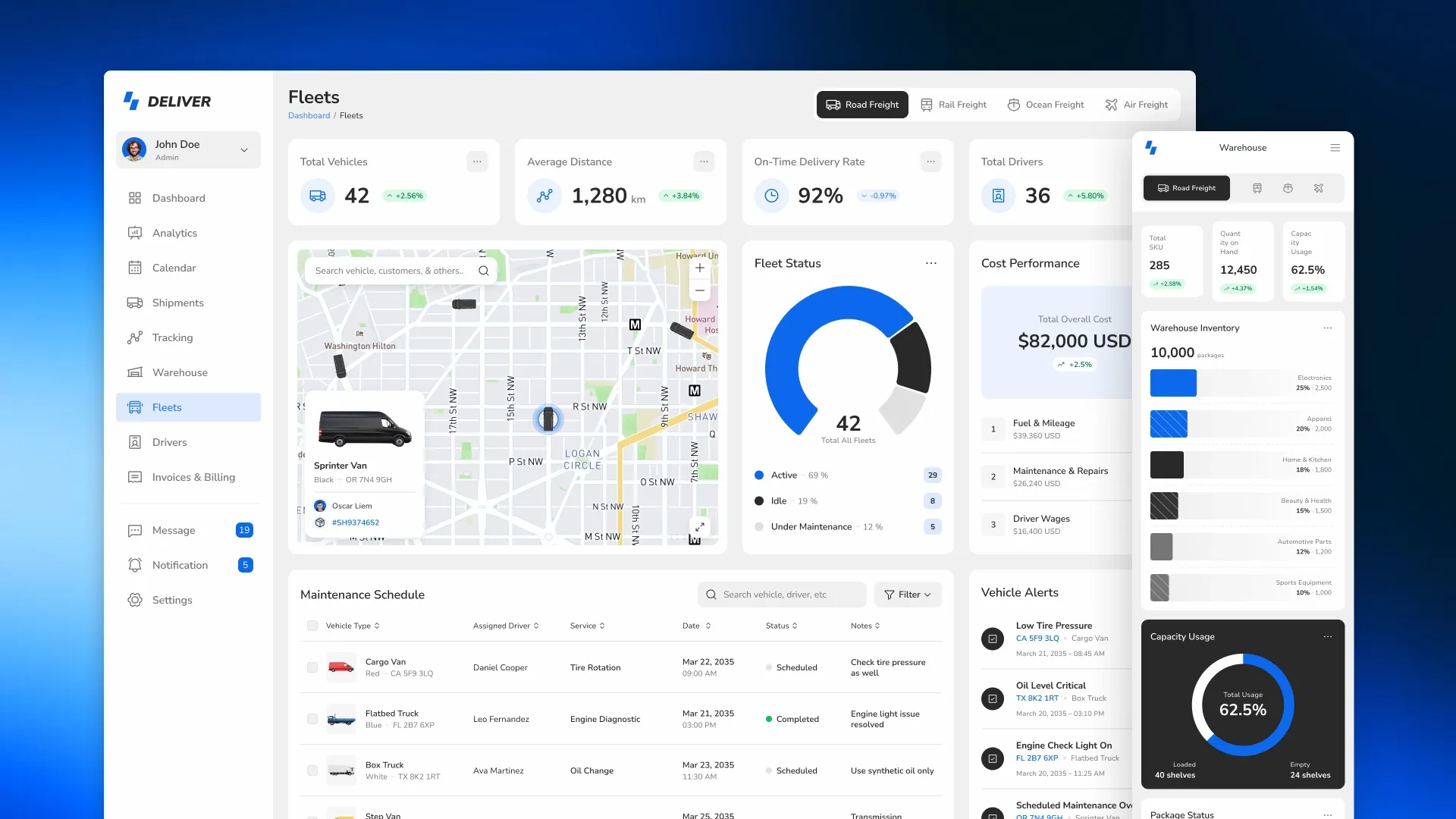
Benefits of using cargo tracking systems:
- Wireless cargo location tracking.
- Monitoring compliance with transportation regulations.
- Monitoring the condition of cargo.
- Reducing manual control costs.
- Control of fuel consumption when using your own fleet of vehicles.
- Identifying "blind spots" in logistics.
- Reducing the risk of cargo theft.
- Reducing operating overhead costs.
Simply put, using a monitoring system, a company can manage its supply chain 24/7 until the cargo reaches its destination. All cargo movement information is stored in a database, and its analysis allows for the detection and elimination of potential process issues to improve transportation efficiency.
In this article, we'll discuss the development process for monitoring and tracking systems, as well as the technologies used.


Choosing a technology stack
Applications for monitoring cargo transportation can be developed for different operating systems and platforms, and therefore, their implementation will involve different technologies:
- Mobile apps. These can be installed on any device running iOS or Android, and are attractive for their portability — they allow you to monitor logistics literally "on the go," without being tied to a desk. They are developed using native technologies: Swift and Objective-C for iOS, and Java and Kotlin for Android. Additionally, there are technologies that allow you to create cross-platform apps that use a single codebase to run on both operating systems, such as the Flutter framework and the Dart programming language.
- Desktop applications run on a PC or laptop as a standalone application. They can be created using PHP and its frameworks Yii2 and Laravel, or Python and the Django/Flask frameworks.
- Web applications. These can run on different operating systems and devices, as they rely on a browser interface. The frontend of these solutions uses static HTML, CSS, and JavaScript, or reactive technologies such as Vue.js and React.js. The backend can be built in JavaScript using Node.js, or in PHP/Python and their frameworks.
The development team selects the technology stack before technical development begins. This is a fundamental step that impacts software performance, implementation speed, and many other parameters.


Stages of development of cargo monitoring systems
The process of developing cargo tracking systems consists of six main stages, divided into sprints. In each sprint, the Scrum team is given a clear task and a limited time to complete it, so the client always knows what work is currently being done and when it will be completed. Furthermore, to ensure the software accurately meets the client's plans and expectations, communication and presentation of the results are conducted at the end of each sprint.
When developing such complex systems, there can be quite a few sprints, so to describe the development process in more detail, let's take a closer look at the main stages.
Step 1. Collecting information
The development of any software begins with information gathering. Here, specialists must define the project's goals and objectives, what tasks it will perform, and how it will integrate into the company's current IT infrastructure. To answer these questions, online or offline meetings are held with the client or their representatives.
Stage 2. Design and preparation of technical documentation
Once all the necessary data has been obtained, the developers begin creating a prototype. This is a schematic model of the future software, reflecting the core logic of its operation, which includes:
- mockups of unique interface pages;
- description of all functionality;
- navigation system;
- description of external services that will be integrated into the project.
Once the prototype is ready, it is presented to the client and revised as needed. After final approval, technical documentation for the project is compiled, the technology stack and implementation plan are determined.
Stage 3. UI design development
The cargo tracking system must be not only functional but also user-friendly. To achieve this, professional UI designers are involved in the project, creating an attractive visual design based on the approved prototype.
There are two main approaches to design: custom and template-based. Custom development gives the specialist freedom of action and allows for the creation of a pleasing, scalable, and recognizable interface.
Stage 4. Programming
During software implementation, programming languages, frameworks, APIs, and other technologies are utilized to ensure all functional tasks assigned to the project are completed. This phase consists of two parts:
Frontend development. The frontend is the user-facing portion of the software and is created in strict accordance with previously approved design layouts. Its primary role is to ensure reliable interaction between the client and the server. For example, when an operator clicks the "Track Cargo" button, the frontend generates the corresponding request and sends it to the backend, and after processing, displays the result on the screen. If the frontend is built using reactive technologies, it also gains the ability to process some requests automatically, which improves software performance; however, this approach requires a slightly higher investment.
Backend development. The backend is responsible for all processes occurring on the server: data processing, calculations, and interaction with databases and external services via APIs. During backend development, programmers build the logic behind the functionality and ensure its proper operation in accordance with the client's business objectives.

Step 5. Testing
After technical development is complete, it's important to ensure that all the functionality of the cargo tracking system is working properly. To achieve this, the project moves to the testing phase, where QA engineers determine its readiness for release.
There are several levels of testing:
- Unit testing is often performed by programmers and allows them to ensure that each individual module functions correctly.
- Integration – checking the interaction of different system modules.
- Systemic - testing the operation of the entire application.
- Acceptance testing is the verification of software compliance with customer requirements.
If a problem is discovered, the QA engineer creates a bug report and submits the project for revision, after which it undergoes retesting.
Stage 6. Technical support and development
Even with the most thorough testing, users may encounter unexpected errors after the product goes live. These issues are addressed through technical support – developers investigate the bug, identify its cause, and promptly resolve it.
Software development, on the other hand, involves not fixing bugs, but rather improving or developing new functionality. For example, this may be necessary when a client's business expands. In such a case, the development cycle restarts: first, new requirements are studied, a prototype is created if necessary, and adjustments are made to the design layouts, followed by the development of the functionality itself. Afterwards, the changes are tested on the production server and integrated into the existing system as a new patch or update.
Developing cargo monitoring systems in AvadaCRM
Tracking systems provide up-to-date information on the location and condition of your cargo, carrier routes, fuel consumption, and other data that will help optimize your supply chain and reduce overhead costs. This software can be used for all types of transportation and is suitable for companies with their own fleet or using third-party carriers.
AvadaCRM specializes in developing high-load systems for transportation and logistics. Using our extensive experience and innovative technologies, we can implement functionality of any complexity and help bring any of your ideas to life. We have established teams of specialists with well-established communication to handle such projects, who can begin implementation as soon as possible.


FAQ
-
What is a cargo delivery monitoring and tracking system?
The cargo delivery monitoring and tracking system is a software solution that enables real-time tracking of the location, condition, and conditions of cargo transportation using GPS, sensors, and analytical tools.
-
What parameters can be controlled using the monitoring system?
Modern systems allow monitoring of cargo location, temperature, humidity, lighting, packaging condition, fuel consumption, and route adherence at all stages of transportation.
-
What types of transport are cargo tracking systems suitable for?
Cargo delivery monitoring solutions are applicable to all types of transportation: road, rail, sea, and air, ensuring stable operation regardless of the mode of transport.
-
Is it possible to integrate the monitoring system with CRM or ERP?
Yes, monitoring and tracking systems can be integrated with CRM, ERP, and other business systems via API, allowing you to automate logistics processes and centralize data management.
-
How long does it take to develop a cargo monitoring system?
Development timelines depend on the project's complexity, the number of integrations, and the functional requirements. On average, development can take several months and is implemented in stages, in sprints.
-
What benefits does a business receive from implementing a delivery tracking system?
Implementing a monitoring system reduces operating costs, minimizes the risk of theft and loss, increases logistics transparency, and improves 24/7 supply chain control.

