











 604
604
Logistics and transportation are among the most dynamic industries, where efficiency directly depends on accurate planning and rapid response to change. Cargo management, routing, fleet control, and interaction with customers and partners are all unimaginable without digital tools. Combined with TMS (transportation management systems) and WMS (warehouse management systems), ERP and CRM systems for logistics form the foundation of a digital business process management ecosystem: they help companies manage large volumes of data, automate routine operations, reduce costs, and improve service levels.
Our experience developing custom solutions shows that out-of-the-box systems only address typical scenarios and quickly lose effectiveness as requirements grow. When businesses face complex industry specifics, non-standard integrations, or high SLAs, a customized approach and functionality tailored to specific workflows are essential. Therefore, custom management systems allow you to not simply "digitize processes" but also create a competitive advantage.
In this article, we'll explore how ERP and CRM help logistics and transportation companies build effective management systems, what tasks they solve, and which functions are truly important for business.

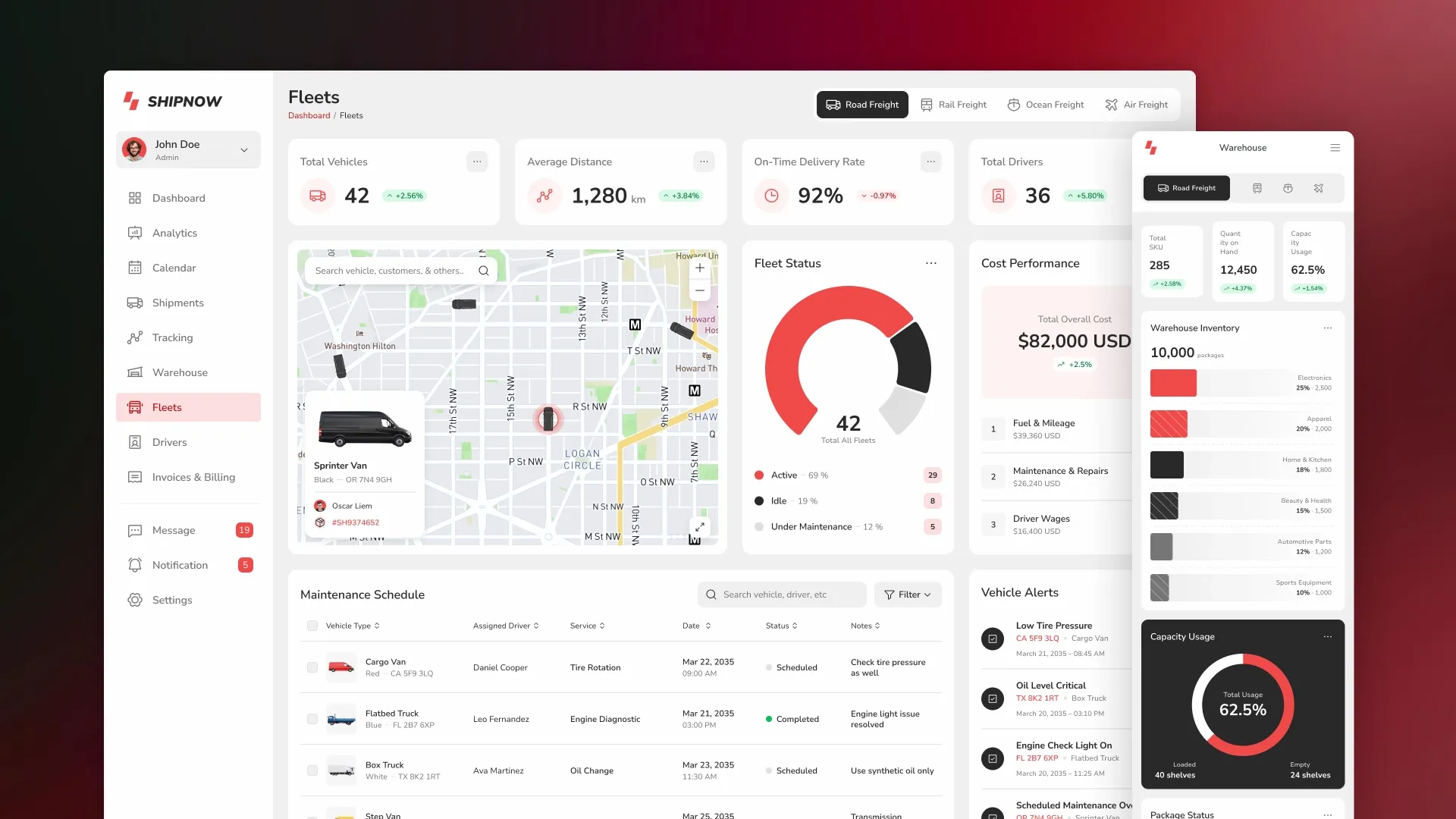
What are ERP and CRM systems for logistics?
ERP (Enterprise Resource Planning) and CRM (Customer Relationship Management) are two key classes of systems that help logistics and transportation companies manage their resources and customer relationships. Despite their different purposes, when combined, they form a unified digital space where every operation is transparent: from route planning and inventory control to customer communication and service quality control.
ERP for logistics
An ERP system acts as the "central brain" of a business. It allows you to:
- comprehensive management of warehouses and vehicle fleets;
- control the movement of orders and cargo;
- track financial flows;
- Integrate data from various sources (GPS, warehouse systems, accounting) into a single platform.
For logistics, this means the ability to see the current picture in real time and make management decisions based on accurate data, not assumptions.
CRM system in logistics
CRM systems for logistics focus on the client side of the business. They help:
- quickly process orders and requests;
- keep a history of interactions with clients;
- build personalized communications;
- provide high-quality service support.
In a highly competitive environment, logistics CRM is becoming a tool that retains customers and increases their loyalty. Custom CRM development, with functionality tailored to a specific company's needs, helps maximize this potential.


CRM system for logistics: Tasks and functions
A CRM system for a transport company becomes a tool that helps optimize internal functions and improve the quality of customer service.
- Automation of sales and customer processes – a unified customer and order database, sales funnel, personalized communications, integration with IP telephony and instant messaging.
- Organize employee work – create a task calendar and reminders, distribute work among managers, and quickly transfer deals within the team.
- Electronic document management – contract templates, invoices, packing lists, proformas, automatic document filling and centralized storage.
- Customer notifications – automatic SMS and push messages about delivery status, changes in terms, or new promotions.
- Analytics and reporting – tracking employee KPIs, analyzing transportation profitability, and automatically generating reports for management decisions.

ERP/CRM technologies for logistics
Modern ERP and CRM systems for logistics professionals are built on digital solutions that make processes transparent, flexible, and predictable.
GPS and IoT sensors
The latest GPS modules and IoT devices (temperature, humidity, vibration, and fuel level sensors) allow not only real-time visibility of cargo and vehicles but also monitoring of their condition. For example, when transporting medications or food, temperature sensors detect the slightest deviations from normal conditions and transmit a signal to the system. In the event of delays or downtime, the system automatically notifies the dispatcher and can adjust the route to minimize losses.
Big Data and Analytics
Big data collection systems analyze not only current routes but also historical shipments: traffic jams, seasonal peaks in orders, average customs demurrage time, and fuel consumption by vehicle model. These data sets are used to generate forecasts: where and when delays are likely, how to distribute orders among vehicles for optimal loading, and which route will be most cost-effective in terms of time and cost. Essentially, this is a predictive logistics tool that helps make decisions one step ahead.
Integration with external services
Modern corporate logistics platforms connect with dozens of third-party solutions:
- Customs systems – automatic data transfer to facilitate international transport;
- Payment gateways – instant settlements and cashless payments;
- WMS and warehouse solutions – synchronization of inventory data, automatic distribution of goods across warehouses;
- GPS monitoring services and transport platforms – unified control over the entire fleet and cargo.
This integration transforms ERP/CRM into the central "nerve center" of logistics, bringing together data from various sources. This eliminates gaps between individual stages of the supply chain, accelerates processes, and reduces the likelihood of human error.


Automation of routes and delivery processes
Efficient delivery in logistics is impossible without automation. Here, the key role is played by the integration of ERP and CRM, complemented by specialized systems – TMS (Transport Management System) and EAM (Enterprise Asset Management) . Together, they form a unified digital space: ERP is responsible for resources and finances, CRM for customer interactions, TMS for transportation planning and control, and EAM for vehicle fleet maintenance and management.
Route planning
Modern TMS systems use algorithms that take into account traffic jams, roadworks, customer schedules, warehouse occupancy, and even weather conditions. Sensors and GPS devices transmit signals about the route situation, after which the system suggests possible adjustments. The dispatcher makes the decision, and IoT technologies simply provide accurate data for analysis. This approach helps reduce idle runs and respond quickly to changes, increasing delivery efficiency.
Fleet management
Equipment condition data is collected from onboard systems, including fuel level, mileage, errors, and maintenance schedules. EAM is responsible for scheduling and monitoring maintenance, preventing accidents and reducing repair costs. When paired with TMS, the system also monitors driver work and rest schedules, helping to ensure compliance and maintain productivity.
SLA and delivery time monitoring
The TMS records SLA compliance for each flight and immediately alerts to potential delays, such as border downtime, equipment failures, or force majeure. Integration with the CRM automatically notifies clients of the shipment status, while the ERP records financial impacts and updates analytics. This triple-layered approach ensures not only route control but also transparency for the business and customers.

Examples of ERP/CRM use in logistics and transport
Real-world implementation cases demonstrate how ERP and CRM systems for logistics help companies reduce costs, streamline processes, and improve customer service. Below are two case studies, but you can explore many more examples in our portfolio.
Case 1. CRM for the logistics company "Normandica"
A prime example from our portfolio is a project for Normandica, one of the largest auto logistics operators in southern Ukraine.
The challenge: The business approached us for a comprehensive turnkey solution - from website to CRM system and marketing setup.
Solution: We designed a CRM architecture and migrated key business processes into it. The system implements roles for administrators, managers, dealers, and accountants, as well as integrations with car auctions and internal services. We also developed a modern website with shipping and customs clearance calculators, a responsive interface, and enabled advertising campaigns.
Result: The logistics company's CRM system created a fully digital ecosystem, combining order management, customer service, and marketing into a single solution. This accelerated request processing, increased sales, and propelled the business to new heights.
Case 2. QSS Web System for Maritime Logistics
We developed a web application QSS, a company that inspects cargo on ships of all types.
The client needed a user-friendly tool for inspectors that would allow them to record inspection results on-site and quickly transmit the data to customers.
Solution: We created a system where inspectors create task cards, add cargo photos and geolocation, and enter inspection and measurement results. Customers have a separate access level – they receive official reports in PDF format and can manage invoices within the system.
Result: Automated inspections and document flow reduced data processing time, increased transparency, and improved customer service.

Conclusion
Modern digital logistics solutions don't operate in isolation, but as an interconnected ecosystem. ERP manages resources and finances, CRM focuses on customers and orders, and specialized modules integrate with fleet management, warehouses, and external services. This is why CRM, logistics, and warehouse management systems work seamlessly together, creating transparent business processes and a unified management platform. This approach allows companies to control every stage of the transportation process, reduce costs, and improve customer service.
Our team's experience shows that universal, out-of-the-box solutions are insufficient here. Only a custom-developed ERP or CRM can address the specific needs of a specific company – from integration with GPS sensors and warehouse systems to document automation and customer service.
Order a custom CRM development for logistics from us and receive a digital solution tailored specifically to your business needs.


FAQ
-
How does ERP differ from WMS and TMS in logistics?
ERP covers all company resources: finance, personnel, procurement, warehouses, and transportation. WMS (Warehouse Management System) is responsible exclusively for warehouse management, while TMS (Transport Management System) is responsible for transportation management. When combined with ERP, they provide complete control over the entire supply chain.
-
How much does it cost to implement CRM for a transport company?
The implementation price depends on the business scale, the number of integrations, and the level of customization. There is no one-size-fits-all pricing plan: for some companies, a basic logistics solution is sufficient, while others require a comprehensive ecosystem with ERP, CRM, and mobile apps.
-
Should you use both ERP and CRM?
It's best to use them together. ERP is responsible for managing the company's internal resources - warehouses, finances, vehicle fleet, and procurement - while CRM handles the customer side: sales, service, and communications. Together, they form a unified system where business processes and customer interactions are interconnected. This approach helps avoid gaps, improve efficiency, and create a transparent logistics management ecosystem.
-
Is it possible to integrate ERP/CRM with mobile applications for drivers?
Yes. Modern solutions support mobile apps, GPS trackers, and IoT sensors. Drivers can receive assignments, track trips, and transmit data to the system in real time.
As an example, consider AvaCRM - a chat-oriented mobile app with extensive integration capabilities. It combines a messenger interface with the functionality of a modern CRM, runs directly in the browser, and works equally effectively on mobile and desktop devices.
-
Is CRM suitable for small logistics companies?
Yes. For small companies, we offer modular logistics CRM systems that easily scale as your business grows. You can start with basic functionality - a CRM for order and customer management, coupled with WMS/ERP integration (stock balances, statuses) - and then gradually expand the system with new modules: fleet monitoring, analytics, and mobile apps for drivers. This approach allows you to avoid unnecessary start-up costs and build the system step by step.

