











 1033
1033
Logistics is one of the most complex industries, requiring high precision, coordination, and lengthy calculations. And when the COVID-19 pandemic led to a sharp increase in online shopping, it became an unprecedented stress test for the global supply chain. This increased workload increased the need for logistics companies to automate processes that help optimize and expedite cargo transportation at all stages – from production to delivery to the end consumer.
What are the benefits of transport logistics automation?
In today's logistics industry, where millions of transactions are processed daily, accuracy and speed are crucial to the success of the entire business. Tracking cargo, routes, and delivery times – all of this requires not only attention to detail but also a significant investment of time and effort. And the larger your company, the greater the risk of errors, as human error inevitably plays a role. But automation opens up entirely new opportunities for companies.
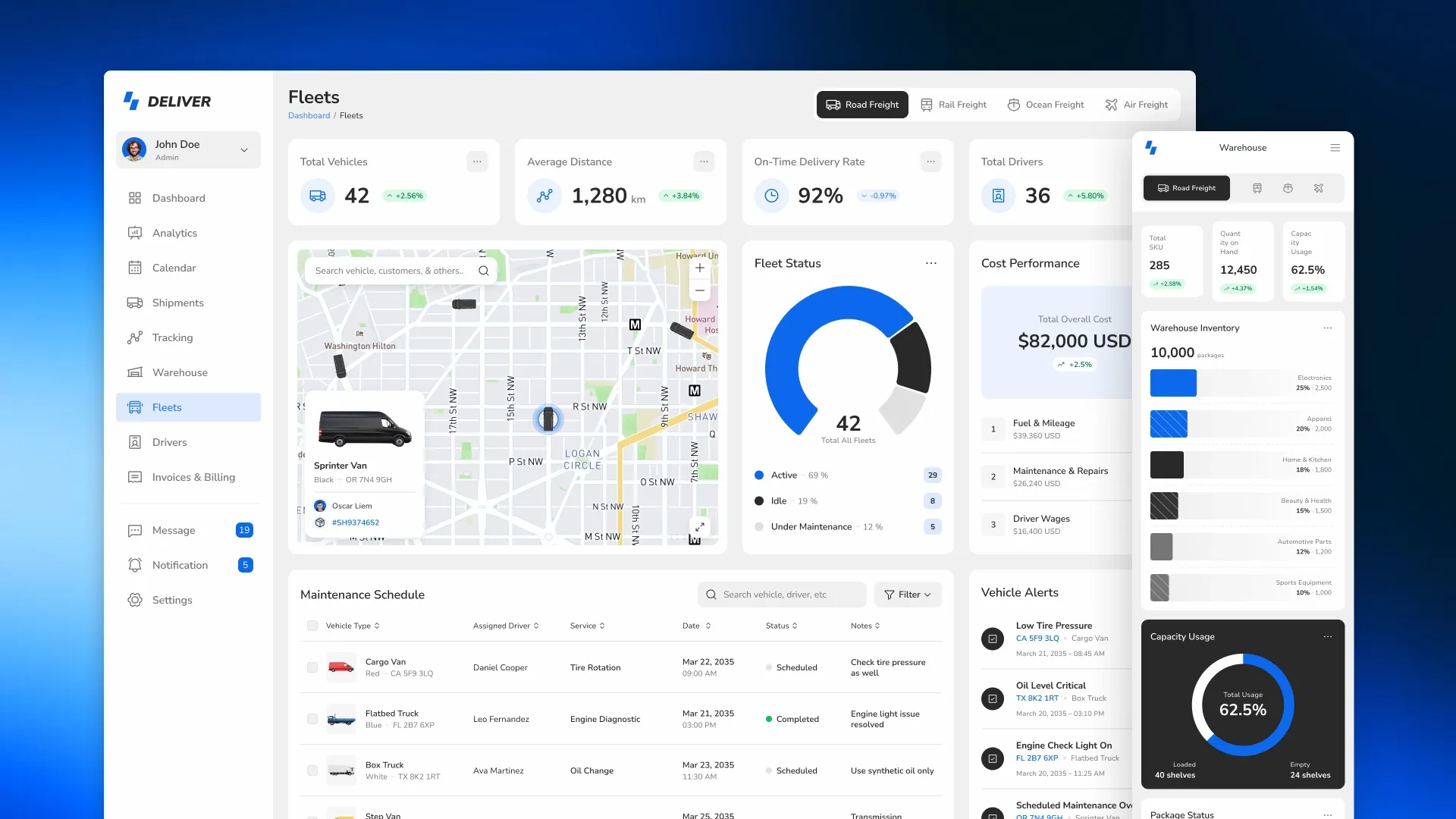
Modern technologies such as artificial intelligence (AI), blockchain, IoT, and virtual reality seamlessly integrate and complement each other, enabling the seamless processing of complex transactions. They also eliminate most challenges associated with cargo transportation, digital security, and documentation.
Let's look at the main advantages that logistics software provides:
- Optimizing order fulfillment costs. Automated systems reduce costs by optimizing routes, selecting the most efficient delivery methods, and automatically distributing tasks among employees. This helps avoid unnecessary expenses on fuel, time, and labor.
- Effective inventory management. Modern logistics software utilizes various IoT devices and computer vision to accurately track inventory in real time. This allows companies to obtain reliable data on the quantity, location, and condition of products in the warehouse. This reduces the risk of shortages or overproduction, simplifies warehouse management, and facilitates more effective purchasing planning.
- Reduced delivery times. Automation systems help process orders and organize their delivery faster. Optimized routes and efficient transport management allow orders to be delivered to customers faster, increasing the company's competitiveness in the market.
- Increased delivery volumes. Machines can process significantly more data than humans, and they do so much faster and more accurately, anticipating every step of the task. This allows the company to significantly increase shipping volumes and, consequently, increase profits.
- Reduced risk of errors. The software minimizes human error, thereby reducing the likelihood of errors in order processing and inventory management. This improves overall operational accuracy and reduces the risk of financial and reputational losses.
- Improved analytics and forecasting. Collecting and analyzing logistics data in an automated system enables accurate demand forecasting, long-term calculations, and informed business decisions. This allows the company to operate more efficiently and contributes to its successful development.


Types of software for transport logistics
Transport logistics requires a variety of software solutions to help companies effectively manage both their internal operations and interactions with partners. Let's look at the main types of software most commonly used in this industry:
- Transport management systems (TMS). These programs cover all aspects of freight transportation. Specifically, they help select optimal routes, manage fleets, track deliveries, and maintain documentation, reducing costs and improving business efficiency.
- Supply chain management (SCM) software integrates all stages of the supply chain into a single system, improving coordination and increasing logistics efficiency.
- Fleet management systems (FMS) are designed to monitor and manage company vehicles. Specifically, FMS monitors vehicle condition, schedules maintenance, analyzes fleet efficiency, and optimizes transportation routes.
- Route mapping systems are used to optimize logistics routes. They help determine the fastest and most cost-effective routes, taking into account road conditions, travel time, and other factors.
- Asset tracking systems. These systems allow tracking the location and condition of transported goods, thereby increasing transparency and control at all stages of the logistics chain.


Types of logistics automation software
Depending on the line of business and business model, companies may have different needs from a technological point of view.
CRM systems for logistics businesses
In the transportation business, CRM allows for monitoring cargo delivery at all stages of the logistics chain and automatically assigning tasks to responsible employees. Such systems contain all the necessary tools in a single interface and can also integrate with other programs the company already uses.
The main tasks performed by CRM in logistics:
- systematization of work with clients;
- optimization and planning of operational activities;
- secure storage and quick access to client data;
- conducting marketing analytics;
- increasing the speed of response to customer requests;
- automation of routine tasks;
- Effective planning of a company's development strategy based on real analytical data.
When developing a custom CRM system for a business, we consider all the specifics of its operation, significantly increasing the effectiveness of the software solution compared to standard, universal products.
Grain and container terminal management systems
Intelligent systems for managing grain and container terminals are designed to protect companies from various errors during the receipt, shipment, and transportation of grain crops. They also help reduce production losses and improve employee efficiency.
The main tasks performed by such systems are:
- selection of the optimal transport route for the transportation of goods;
- control of employees' work;
- remote control of the handling complex;
- Monitoring the technical condition of the vehicle fleet and automatically sending notifications about the need for maintenance.
- qualitative and quantitative accounting of products.

Warehouse logistics software
Warehouse logistics software is used to account for, manage, and distribute inventory. It helps organize the efficient delivery of goods to the end consumer and often works closely with a company's transport logistics services.
The main tasks that warehouse logistics software can perform are:
- efficient warehouse management;
- unification of cargo to optimize financial costs;
- accounting of receipt and dispatch of goods;
- optimization of distribution logistics;
- adjusting the product range based on customer demand;
- accounting of work related to additional processing of goods in warehouses – packaging, sorting, etc.
Software for maritime and container shipping
Sea container shipping software helps optimize document flow, taking into account customs regulations across different countries, and automates shipping cost calculations and customer interactions. This allows businesses to reduce the operational burden on employees and focus on growth.
Some important functions that such software can perform are:
- quick creation of a transportation order and reservation of space in a container;
- automatic invoicing of clients;
- seamless transfer of customs declarations;
- cargo location tracking;
- documentation control;
- planning the placement of containers and individual cargo.
In the container shipping industry, large companies often prefer decentralized solutions. Blockchain technology increases project transparency and security, and reduces the costs associated with legal support for transactions through the use of smart contracts.
Driver apps
This software is often installed on a smartphone and provides the driver with all the useful information regarding route optimization, documentation, and vehicle maintenance. For example, the app may include the following features:
- storage of digital versions of documents: driver's license, insurance policy and vehicle registration certificate;
- fuel consumption control;
- search for the nearest gas stations with current fuel prices;
- GPS tracking and route planning;
- troubleshooting a car;
- fast payment of fines.

Company logistics
These systems are designed to optimize a company's logistics. They store information about the fleet and drivers, cargo, customers, and scheduled shipments, and perform a number of important functions:
- building and editing driver routes;
- delivery planning by geographic zones and time windows;
- real-time transportation monitoring;
- quick search for information about drivers, couriers and cargo;
- maintaining a client base;
- maintaining document flow related to the transportation of goods: consignment notes, invoices, certificates, etc.;
- convenient processing of product returns;
- courier cash register processing.
Using specialized applications makes company logistics as convenient and transparent as possible, and also improves customer service, as shipments will always be delivered on time thanks to high-quality planning.
Transport access control and management system
Access control and management systems, or ACS for short, are designed to restrict vehicle access to enterprise facilities. They automatically recognize a person or vehicle attempting to enter a secure area and independently make a decision on access authorization based on programmed data.
Such systems can be used to ensure the security of facilities, monitor employee working hours, maintain a database of company personnel and visitors, and for many other purposes.
Automated weight and dimension control systems
These systems are installed across the roadway and automatically record the weight of vehicles passing over them, as well as determine the load on each individual axle. This is necessary to prevent excessive stress on the road surface.
ASVK systems are capable of automatically reading the necessary vehicle data from hardware devices – scales, video cameras, and so on – analyzing it and making decisions regarding authorization of passage.


Automation of commercial roads and crossings
Commercial road software enables companies to fully automate the payment and vehicle clearance process, as well as maintain accurate statistics for business performance analysis.
Such systems can also be equipped with weight and dimension control, which will allow the toll amount to be calculated based on the load the vehicle places on the road surface.
Automation of parking complexes
Automatic pricing systems in parking complexes perform several functions at once:
- recording the time a vehicle spends in the parking lot, taking into account timeouts when the vehicle temporarily leaves the complex;
- online payment acceptance;
- maintaining accurate statistics;
- reduction of personnel costs;
- increasing the convenience and competitiveness of parking.
Software packages for taxis
Taxi dispatch systems and fleet management systems are used to automate routine tasks and increase order processing speed. They can include multiple interconnected modules and systems developed in accordance with each company's internal business processes, such as:
- CRM systems for business owners
- personal accounts for operators;
- Mobile applications for drivers designed to accept orders, record journey times using GPS, and calculate trip costs;
AvadaCRM specialists can also develop car rental systems. These include a dedicated user app for clients and a built-in GPS tracker with embedded development—the programming of the car's software itself.
This way, the company can track the location of a vehicle at any time, no matter where it is.

Why invest in custom transportation management software development?
Even today, many logistics companies rely on human resources for their operations, and their digitalization is, in most cases, limited to the use of spreadsheets or standardized “out-of-the-box” solutions.
However, the market dictates its own terms. Modern users have long been accustomed to convenience and expect purchases to be in their hands within hours, which is why they demand ever-higher speed and accuracy from businesses. And achieving this without customized software that takes into account your company's unique processes is virtually impossible.
At AvadaCRM, we understand the challenges and difficulties logistics businesses face daily, and we offer innovative digital solutions to help them overcome them. Let's explore the key reasons why it's worth investing in custom software.
Economic rationality
The availability of off-the-shelf software is more of a stereotype than a fact. Integrating a ready-made program into the processes of a large logistics company can take several months and require significant investment. Moreover, the effectiveness of such a product is questionable, as it only addresses business needs superficially. Therefore, it makes more sense to redirect budget and time toward the implementation of customized software, created from the ground up to meet your company's unique needs.
Relevance of technologies
Most standard supply chain IT solutions have been on the market for decades. These programs are characterized by technical limitations, which pose a significant obstacle to their integration into modern businesses.
By choosing custom development, you're taking a step toward innovative technologies that are more efficient, easily scalable, and meet your company's current needs. For example, by developing your own software, you can delegate data processing and route planning to AI, and delegate cargo status monitoring to IoT devices. This will ensure maximum accuracy and speed for your business.
Compliance with requirements
Logistics is a complex and diverse market, where each company has its own specific needs, niche, and unique internal processes. Therefore, there is no "universal" software for this industry that would be equally effective for everyone.
Custom development, on the other hand, allows you to take into account the specific needs of your business: the nature of your operations, the logic of interactions with clients and partners, and any necessary integrations. Moreover, such software can be continuously expanded as your company grows, ensuring it remains relevant over time.
Safety
Custom software is the best solution in terms of cybersecurity. It gives companies complete control over their data and eliminates the possibility of confidential information leaking from third-party platforms and services.


How to order logistics software development in AvadaCRM?
Starting a collaboration with an IT company is always a bit nerve-wracking. Every entrepreneur wants the development team to fully understand their needs and the end result to fully meet their expectations. Therefore, to avoid the risk of misunderstandings or misinterpretations, we have established a highly transparent process with the client from the very first communication.
This is how the beginning of cooperation in our company is organized:
- You leave a request on the website with a description of your project.
- Our specialists will carefully review your request and contact you to clarify project details, answer your questions, and offer the optimal technical solution.
- Once the project goals are defined, we perform precise timeline and budget calculations, define software quality criteria, and then formalize them in the contract.
- We assemble a team of developers and begin implementing your software, strictly adhering to your requirements and deadlines.
Why Choose AvadaCRM for Logistics Software Development
Automation of logistics processes is not just a trend, but a necessity for modern companies. Investing in custom software development will allow you to take your business to a new level of efficiency, reduce costs, and minimize risks associated with human error.
AvadaCRM creates innovative software for automating transportation and logistics processes both within companies and between business partners. Our solutions include fleet and warehouse management systems, route mapping, asset tracking, and other digital solutions that improve the efficiency and competitiveness of companies in this industry.
By contacting us, you receive not only cutting-edge software, but also the confidence that all processes will operate smoothly and efficiently, which will be the key to your company's success in the market.


FAQ
-
Do you follow current trends when developing logistics software?
Today, logistics software development is focused on integration with artificial intelligence and machine learning for route optimization and inventory management. Much attention is paid to cybersecurity and disaster resilience, as well as cloud solutions for increased flexibility and scalability. At AvadaCRM, we take into account all current trends to help you implement the most efficient, reliable, and functional product.
-
Which companies benefit most from implementing logistics optimization software?
Custom software is essential for large enterprises with complex and non-standard supply chains. This is especially important for companies in the freight transportation, e-commerce, manufacturing, and retail sectors. Custom solutions help them more effectively manage unique logistics challenges, reduce costs, and improve product delivery speeds.
-
How much does it cost to develop a custom logistics program?
Development typically costs around $10,000. However, it's important to understand that the cost depends on the required functionality and the software's complexity, so the cost can vary significantly. At AvadaCRM, we always recommend starting the project with the design phase, as this allows us to calculate an accurate price and find the optimal balance between budget and functionality.

