









CRM for barbershops
Barbershops are men's beauty salons where customer service is always paramount. This isn't just due to high competition - customer focus is part of the business's DNA, so a high-quality CRM system is essential. Such a system will help your company improve customer interactions, automate internal processes, and monitor the work of your barbers, thereby enabling faster growth and expanding your client base.
Which barbershops need a customized CRM?
Up to a certain point, companies can still operate "the old-fashioned way" and track clients in a Google spreadsheet or with a standalone CRM. For example, if the number of visitors per month doesn't exceed 20, these tools may be sufficient. However, if you employ several professionals, have a range of material suppliers, and a steady flow of clients with unique needs, a customized CRM system is essential. It will help you automate most internal processes and develop a personalized approach to each client.
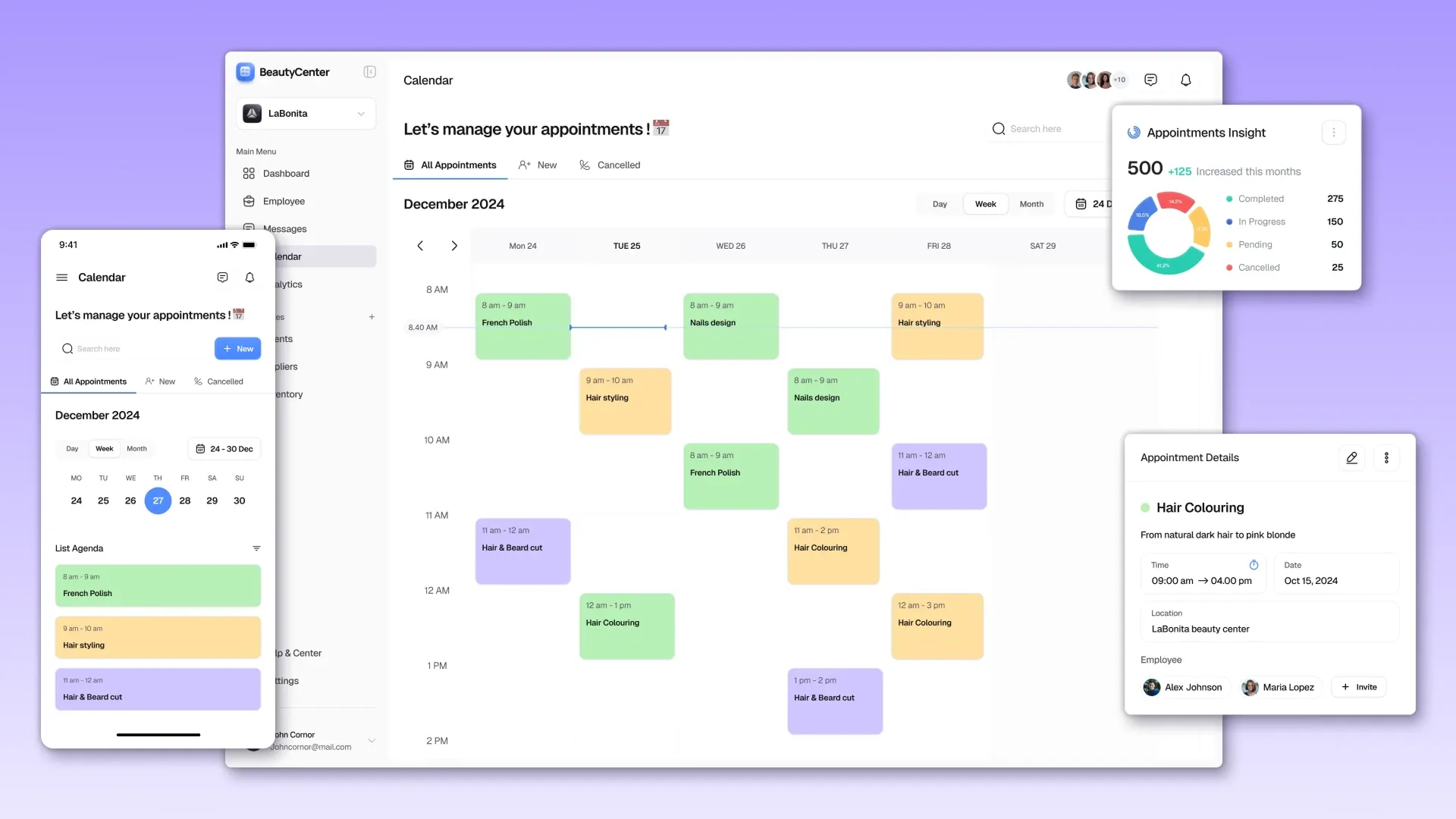
The AvadaCRM team has extensive experience developing CRM systems for the beauty industry. We developed CRM Helper - a flexible, scalable, and user-friendly CRM system specifically for beauty salons, barbershops, and private stylists. The system automates key business processes: online client booking, scheduling, client database management, inventory control, financial reporting, and loyalty programs.
In this project, we conducted an in-depth industry analysis, designed a user-friendly UX/UI, implemented all functionality with the ability to customize it to meet the needs of each salon, and ensured operational stability through rigorous QA testing. The result is a ready-to-use SaaS product, successfully launched on the market, which is already helping beauty businesses optimize operational processes and increase efficiency.


CRM functionality for barbershops
CRM systems for barbershops offer extensive functionality and help make customer service and administration simpler and more convenient. Key features of such systems include:
- Automation. Many routine barbershop tasks can be easily automated, such as sending reminder notifications to clients about their appointments, informing the barber about new appointments, sending out newsletters with special offers or new services, and more.
- Scheduling. The scheduling system synchronizes all application channels: website, social media, and phone. This eliminates the risk of clients booking appointments at the same time.
- Client database management. The CRM stores information about all visitors and their interaction history. This means clients don't have to explain their preferences to the stylist every time - all this information is already in the database. Furthermore, if someone hasn't visited the salon in a while, you can try to win them back with special offers.
- Time tracking for technicians. Helps manage staff workloads and distribute orders more efficiently.
- Materials accounting. The warehouse management system will help you monitor the level of materials and consumables in each salon.
- Gathering analytics. Up-to-date analytical information about your barbershop's operations will highlight the company's strengths and weaknesses and help identify optimal growth opportunities.
Every barbershop operates differently, and the main advantage of a customized CRM is that it's tailored to the business needs of each individual company. Therefore, functionality may vary from salon to salon.
What technologies are used for CRM development?
The technology stack influences many factors: CRM performance, implementation speed, integration with third-party services, and more. Therefore, to select the optimal technologies, specialists need to undertake certain preparatory work:
- study the client's experience in using third-party software;
- get acquainted with the processes within the company;
- formulate a project concept and high-level documentation.
Additionally, the devices your barbershop staff will use the CRM on is important. For example, administrators will be more comfortable using the desktop version, while barbers will prefer the mobile app, as they aren't constantly near a computer. Meanwhile, the web version of the project can function on both smartphones and PCs simultaneously. Taking these factors into account, the technology stack might look like this:
- for mobile applications: Swift programming language for iOS and Java/Kotlin for Android, or the Flutter framework and Dart language for cross-platform development;
- For desktop applications: Python and Django/Flask frameworks, PHP and Yii2/Laravel frameworks, or C++.
- For web applications: for the frontend - static technologies HTML/CSS/JavaScript or reactive Vue.js/React.js, and for the backend - Python/PHP/Node.js.

How does the development process work?
There are various software development methodologies, but when creating a CRM, we prefer SCRUM. Its concept is quite simple: the entire workload is distributed among team members and completed in short sprints. Each sprint has a clear deadline and goal, ensuring the client always knows what work is currently being done and what the desired outcome should be. Another advantage of the iterative approach is that it ensures flexibility during development. This means that new ideas from the client or the team can be easily implemented at any point during the CRM's development, which positively impacts the quality of the result.
In addition to the methodology, there are six other main stages of development. Let's look at the work performed at each of them.
Step 1. Collecting information
Before starting technical development, our specialists conduct research. To create an effective product, they need to understand your company's business processes, marketing cycles, existing IT infrastructure, and experience using similar software. To answer these and other questions, we organize meetings or online workshops with client representatives.
Stage 2. Design, documentation and technology selection
Once all the necessary information has been obtained, the project moves on to the design phase. Here, specialists are tasked with creating a prototype of the future CRM and defining its functionality. Typically, the prototype includes:
- mockups of system pages and interfaces;
- detailed description of functions;
- navigation system between pages;
- technology stack;
- development plan.
Next, the team needs to align its plans with the client's vision. To do this, we present the work completed and, if any new ideas arise, integrate them into the prototype.
Stage 3. Design development
Despite a CRM system's multitasking capabilities, its interface should remain simple and user-friendly. This is important because working in a comfortable environment will allow your staff to adapt to new software more quickly and minimize the likelihood of errors in customer service. To achieve this, CRM design is often customized, taking into account the functionality and specific usage patterns of a specific company.
Stage 4. Programming
The programming phase is not only the most labor-intensive but also the most challenging to understand for the client. Therefore, to ensure reliable communication, team leads are involved in the delivery of these sprints. They can answer any questions the client may have and provide recommendations if needed. Generally, software development can be divided into two components:
- Frontend. Creating the client-side CRM system that end users interact with.
- Backend. The server-side implementation, which is responsible for all internal processes - data storage, function processing, interaction with external services, etc.
Step 5. Testing
To ensure the CRM system functions correctly, QA engineers (quality assurance specialists) also participate in sprints. They conduct testing and determine how well the functionality performs as expected.
Stage 6. Technical support and development
Even with the most thorough testing, it's simply impossible to anticipate all real-world system use cases. Therefore, in the initial period after release, users may still encounter errors that weren't previously identified. In such cases, developers are re-engaged to determine the nature of the problem and promptly resolve it through technical support. It's also important to understand that a CRM is a tool that drives business growth and development. Consequently, over time, your barbershop may require new, more advanced functionality, and to bring these new ideas to life, the development cycle repeats: specialists review requirements, design a solution, develop it, and test it on a production server. Afterward, the update is deployed as a separate patch to the existing environment.

Developing a CRM for a barbershop in AvadaCRM
Developing a barbershop CRM with AvadaCRM is an investment in stable staff utilization, high-quality service, and profit growth. We create customized CRM systems tailored to the specific needs of a barbershop: online client booking, staff scheduling management, appointment history, automatic reminders, loyalty programs, and revenue analytics. This system helps reduce no-shows, increase return visits, and streamline the administrator's daily workflow.
AvadaCRM team develops a CRM system tailored to real-world business processes, seamlessly integrating it with websites, messaging apps, payment services, and POS systems, and ensuring scalability for barbershop chains. You don't get a template solution, but a tool that grows with your business and helps you stand out from the competition.
Order CRM development for your barbershop from AvadaCRM today – automate management, improve customer service, and increase your business profits.