









CRM for cargo transportation
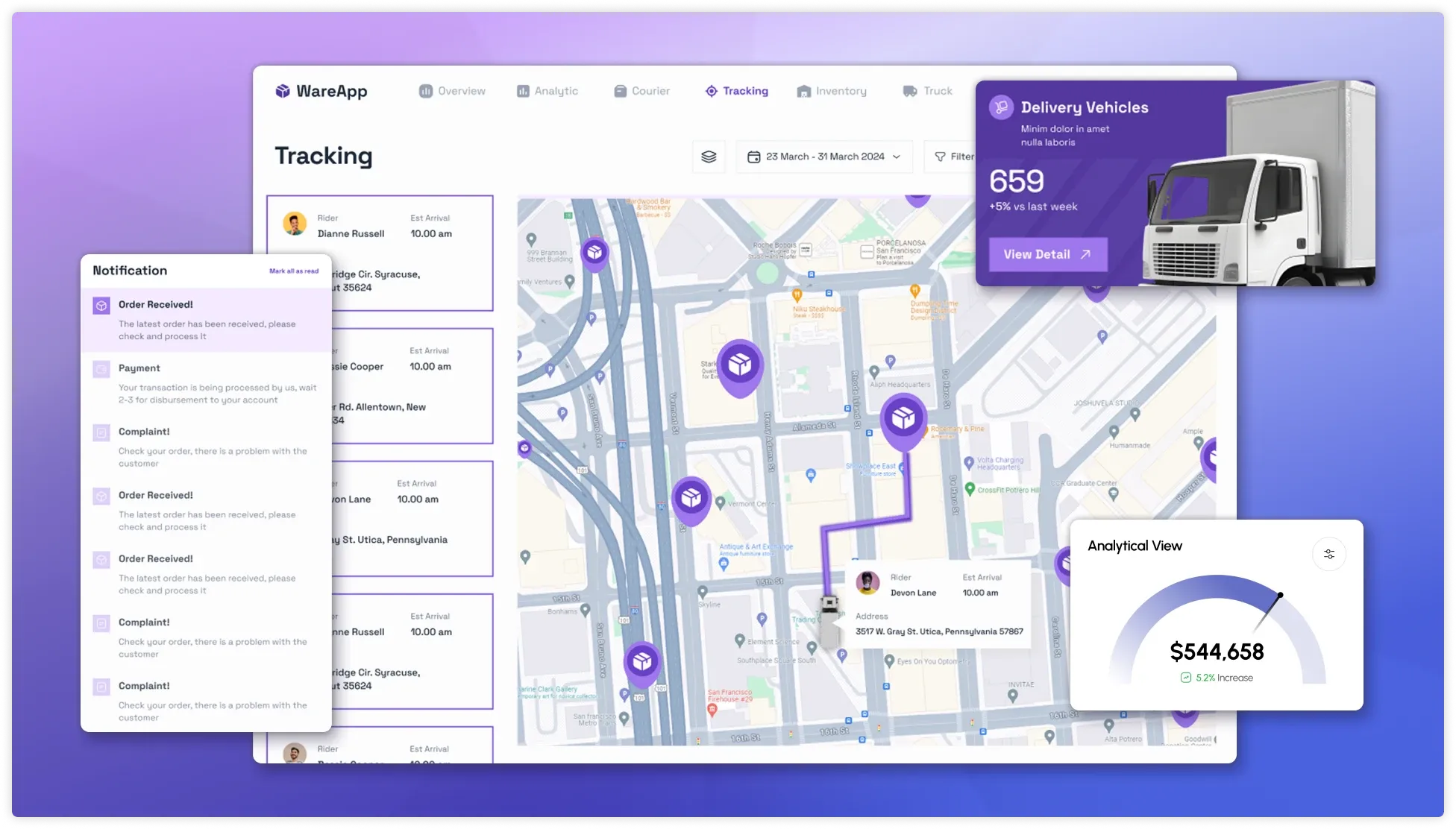
Work in the field of cargo transportation is associated with many processes – from organizing interaction with counterparties to developing routes and maintaining accounting. Managing all this manually is quite difficult, especially given the client's service requirements, which are skyrocketing against the backdrop of high competition. Therefore, automation in this business is indispensable.
CRM for transportation will put the same tasks on the conveyor and allow your staff to focus on more important matters. This will help improve the quality of service and will become an impetus for the development of the company.
What tasks does CRM solve in the transport business
The functionality of CRM can be quite extensive, and is developed for the individual needs of each company. Here are the main opportunities that the introduction of such a system will open up:
- Maintaining a customer base. All information about clients and the history of interaction with them is stored in a single database. Using this information, you will be able to conduct more effective advertising campaigns and increase customer focus.
- Implementation of electronic document management. Bureaucratic procedures not only cause discomfort for customers, but also delay the workflow. CRM will help transfer all invoices, checks, permits and other documents to the digital plane, which will increase the security of transactions and the speed of their processing.
- Optimization and control of personnel work. All transactions in transport companies are carried out according to a certain regulation, which can be entered into CRM.
This will allow employees to set clear tasks with a limited time frame, as well as monitor their implementation.
- Route management. Logistics processes are the most important in freight forwarding companies. The CRM functionality will allow you to build the best routes, as well as track the movement of drivers online.
- Collection of analytics. Up-to-date analytical data will help you objectively evaluate the performance of your business and identify its strengths and weaknesses. This will help to make informed management decisions regarding further development.
- Integration with third party services. Thanks to the possibility of integration, you will be able to implement online payment, connect telephony, website, instant messengers and any other services to CRM, which will make your work even easier and more efficient.


What technologies are used to develop CRM
The choice of a technology stack depends on many factors, including on which devices CRM will be used.For example, for work in the office, the desktop or web version will be the most convenient, and when working in warehouses and for drivers, a mobile application that can be installed on a tablet or smartphone will be more preferable. Accordingly, different technologies will be used to develop each version.In practice, the technology stack might look like this:
- For desktop applications. Python/PHP/C++ programming languages and Django/Flask/Yii2/Laravel frameworks.
- For web applications. HTML/CSS/JavaScript or reactive frameworks Vue.js/React.js for the frontend and Python/PHP/Node.js for the backend.
- For mobile applications. Swift programming language for IOS and Java/Kotlin for Android. The cross-platform Flutter framework and the Dart language can also be used here.
How is the development process
In order for CRM to fully meet the needs of the company, it is extremely important to establish a close relationship with the client during the development process. To do this, we build the production process according to the SCRUM methodology. Its essence lies in the fact that all tasks are distributed among team members and performed in short sprints, which are then presented to the customer. Therefore, the Product owner always knows exactly what work is being done and what the result will be.Also, the iterative approach leaves room for new ideas – if during development the client or the team has suggestions to improve the system, they are discussed and can be implemented in the project at any time. In addition to the methodology, there are stages in the development of CRM. Let's take a closer look at the six main ones.
Stage 1. Gathering information
At the very beginning of the journey, specialists conduct a study, during which they study the company's business processes, its existing IT infrastructure and get acquainted with the experience of using similar systems. To do this, meetings are organized with representatives of the client, at which each issue is discussed in detail.
Stage 2. Design and technical documentation
After collecting all the necessary information, the design stage begins. Developers create a prototype of the future CRM, which includes page mockups and a navigation system between them, a description of the functionality and a development plan. Also at this stage, a technological stack is selected.When the prototype is ready, it is presented to the customer and discussed. As a rule, during such a dialogue, new ideas arise on how to make the system even better. All of them are fixed and then implemented.
Stage 3. Design development
Despite the many processes and tasks that CRM performs, its interface should remain simple and understandable for the user. This will make it easier for staff to learn how to use the new software, as well as minimize the chances of making mistakes.To create a truly comfortable visual environment, CRM design is often developed individually, taking into account the functionality and corporate identity of the company.
Stage 4. Programming
Technical development is the most time-consuming and lengthy stage in the creation of a CRM system. It consists of two parts:
- Frontend. This is the client side of the application, which is developed in strict accordance with the previously approved design. The main task of the frontend is to provide interaction between the user and the server.
- Backend. The server part of the project is responsible for the operation of the functionality, data storage and communication with external services, such as telephony or instant messengers for communication with clients.
Stage 5. Testing
After the development is completed, you need to make sure that the CRM functionality works correctly and in the way it was intended at the planning stage. This work is done by QA engineers.
Stage 6. Technical support and development
After deploying CRM for the first time, your employees may encounter unexpected errors that were not discovered during testing. In the event of such a situation, the problem is studied by the developers and quickly eliminated within the framework of technical support. It is also worth adding that over time, the CRM system can be refined and improved an unlimited number of times. Thus, acquiring new functions and modules, it will grow in parallel with your business. Such innovations are implemented in the format of patches with updates and are installed in an existing system.

Development of CRM for cargo transportation in AvadaCRM
With the help of a customized CRM, you can automate most of the processes in your company, reduce the operational burden on staff and significantly improve the quality of customer service. This will increase your competitiveness and allow you to take your business to a whole new level.
To develop CRM systems, we, at AvadaCRM, use only innovative technologies and employ already formed teams of experienced developers, which allows us to create technical solutions of any complexity.


FAQ
-
How does a CRM system help improve customer service in a transport company?
CRM centralizes data about each client and their order history, allows you to automate communication (SMS/Email/telephony) and provides transparent tracking of transportation statuses – this reduces the number of errors, speeds up request processing and increases customer satisfaction.
-
Can I integrate CRM with other services that my company already uses?
Modern CRM systems for transport often have modules for planning and optimizing routes that take into account traffic, delivery priorities and resource availability. This reduces travel time, reduces fuel costs and increases the efficiency of dispatch services.
-
How long does it usually take to implement CRM for freight transport?
The term depends on the complexity of business logic, integrations and the scale of the company. A simple basic module can be developed in a few weeks, and a complex system with a large number of integrations – in a few months. Specific terms are specified after analyzing the processes.
-
Will CRM help manage drivers’ work and monitor their employment?
Yes, CRM can include modules for driver management: from task distribution and schedules to tracking order fulfillment and work efficiency, which optimizes fleet utilization.
-
How is the cost of CRM development for my company formed?
The cost depends on the scope of functionality, integrations, level of automation and complexity of your business processes. CRM for a small company and for a large logistics operator will differ significantly in price, so an accurate estimate can be provided after a detailed business analysis.
-
What to do if new ideas or needs appear after CRM implementation?
CRM should be flexible: after launch, it is possible to further optimize and expand its functionality in accordance with new business requirements. The support and development stage is provided for in most individual projects.