









CRM for delivery services
A delivery service isn't just a business; it's the art of providing fast and accurate service, which is what distinguishes it from postal couriers. Customers want their orders delivered on time – hot pizza for dinner, fresh flowers for a special occasion. Competition in this niche is rapidly growing, and every order matters, so courier companies can't afford delays or errors. To stay ahead, it's crucial to implement cutting-edge technologies, including ordering a CRM for your delivery service.
Automation will make customer interactions, order management, couriers, and routes easier and more efficient. AvadaCRM will help you create a modern management system that will optimize your business and ensure a high level of service.
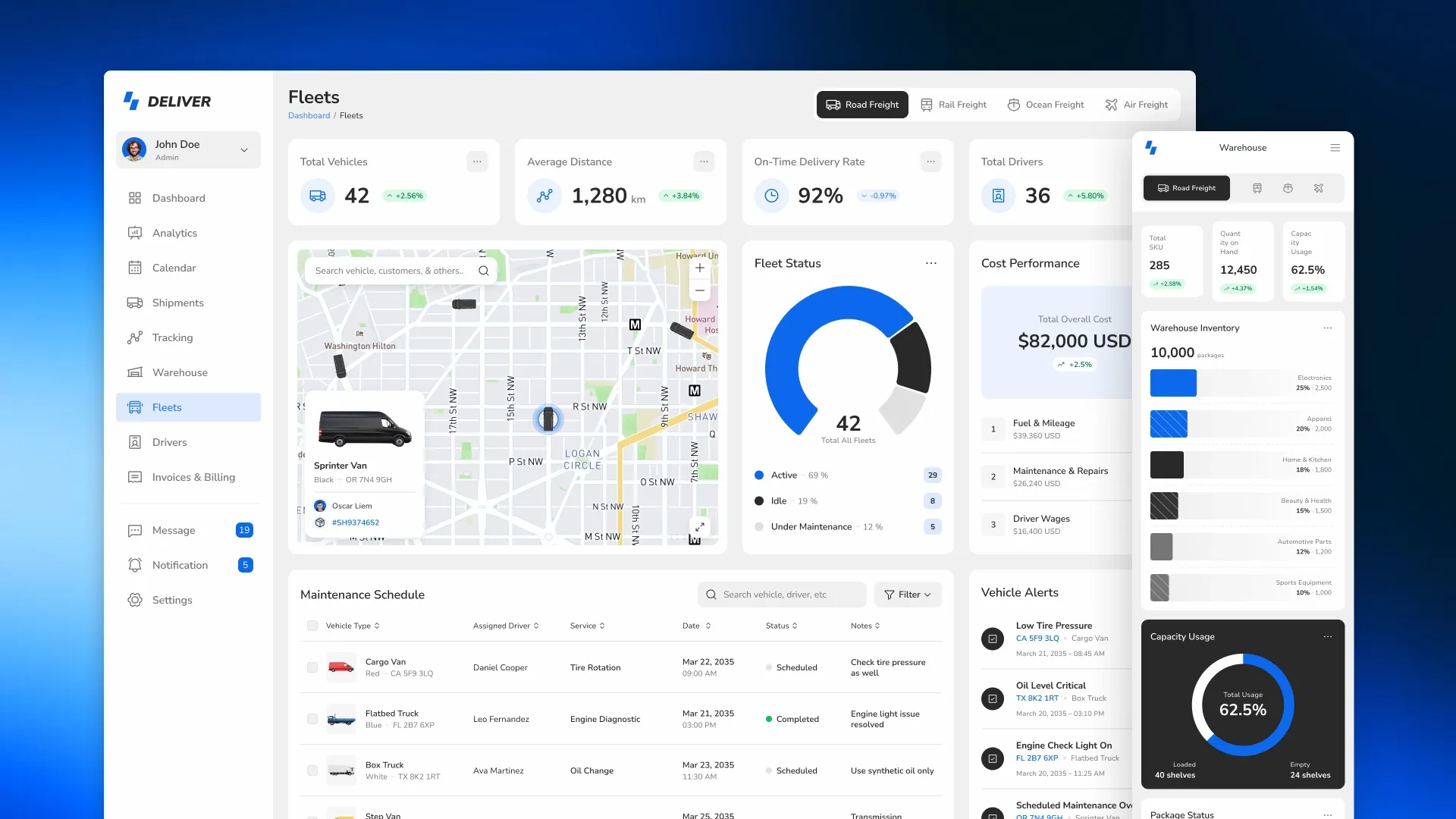
What is a CRM system for a delivery service?
CRM (Customer Relationship Management) is a customer relationship management system that automates a number of key courier service processes. It allows for centralized order management, real-time tracking of couriers, route planning, and customer interaction. Unlike off-the-shelf solutions, a CRM system for a delivery service takes into account the specific requirements of logistics and accelerated request processing. Specifically, when developing a custom CRM for a courier service, it's important to consider high system load during peak hours, the need for rapid order distribution, integration with courier mobile apps, and accurate time calculations. It's also essential to implement a notification system for both customers and couriers to minimize delays and errors.

What tasks does courier service automation solve?
Automating delivery services for food, water, goods, medicine, etc. allows you to scale your business without unnecessary costs or staff increases, as it takes on many key tasks:
- Optimal route planning for couriers saves time and resources. The program helps build a route by point, which not only simplifies work but also reduces idle runs, lowers fuel costs, and improves order fulfillment speed. Furthermore, the route can be designed taking into account various factors, such as traffic jams, road congestion, and couriers' preferences.
- Order management in a delivery service's CRM allows you to record all order details: contents, address, time, and customer contact information. A centralized database of all orders allows you to track them at every stage.
- Improving service quality – maintaining a customer database and storing interaction histories helps personalize and improve service, increasing loyalty and satisfaction. Integration with feedback systems for collecting customer feedback allows for prompt response to issues. A delivery CRM system also makes it easy to manage loyalty programs, bonuses, and discounts.
- Manage couriers by tracking their location in real time and effectively distributing orders based on their qualifications, workload, and specialization. The CRM allows you to implement a courier incentive system and bonuses, thanks to the ability to analyze their performance.
- Generate reports based on key performance indicators (KPIs): average order fulfillment time, most popular routes, percentage of completed orders, customer satisfaction, and courier ratings.
- Intelligent order processing , including a point-by-point route planning program, automatic address recognition and standardization for route optimization, and the ability to account for different vehicle types.
- Automatic notifications about order status (from confirmation to delivery), promotions, and special offers.
- Multichannel support, thanks to integration with various communication channels, including phone, email, and instant messaging, significantly simplifies customer communication. Multichannel support allows you to accept orders from various sources: website, mobile app, social media, and phone calls.
- Integrations with third-party services:
- payment systems (LiqPay, Stripe, PayPal) – for convenient online payments;
- mapping services (Google Maps, OpenStreetMap) – to optimize the route by points;
- marketplaces and aggregators (Glovo, Uber Eats) – for order management;
- GPS trackers – to monitor the location of couriers;
- Warehouse management systems (WMS) – to control the availability of goods.


When is delivery automation needed?
If your courier service handles a large daily flow of orders or you're looking to increase profits by reducing operating costs, a custom management system can solve your problem.
Automation of courier services becomes critical not only when volumes increase, but also when it is necessary to identify and reduce hidden costs, improve couriers' working conditions, increase resilience to force majeure, analyze customer behavior, create a competitive advantage, and effectively plan for future workloads.

Who is a delivery service CRM suitable for?
A courier CRM system is ideal for any company that delivers goods to order. Here are a few examples where implementing a delivery CRM will significantly improve business processes:
Pizzerias
Automating pizza delivery services is crucial for pizzerias. A CRM system helps speed up service and reduce errors when accepting and processing orders. The program helps couriers reach their destinations faster, and helps customers receive their pizza hotter.
Sushi bars and restaurants
A food delivery CRM helps track orders, manage the kitchen and couriers, and optimize routes. Automating sushi delivery is especially important, as products must arrive in perfect condition. A high-quality custom CRM ensures faster and more accurate food delivery.
Supermarkets and grocery stores with delivery
Supermarkets and online stores offering courier services can use a CRM to manage orders, logistics, and couriers. Automating the delivery service helps avoid inventory issues and improve coordination between all parties involved.
Water delivery
Water delivery companies often face fluctuating demand, especially depending on the season or external factors (such as a temporary water outage in a given area). A water delivery CRM helps effectively manage orders, distribute them by district, and monitor couriers.
Flower delivery service
A flower delivery CRM system helps track orders, manage logistics, send customer notifications and bouquet photos, and monitor order fulfillment at any time. Automation of the flower delivery service should ensure the accuracy and speed of couriers, especially during peak periods like March 8 and February 14.
Stages of CRM development for a delivery service
Custom CRM development for couriers takes place in several stages. This approach allows us to create a CRM system that fully meets the company's requirements and helps achieve its goals.
- Analysis and goal setting
At the initial stage, analysts conduct a detailed business analysis, examining current processes and business challenges, CRM development goals, and the client's wishes. This should result in a clear list of requirements and tasks that the future system will address.
- Technical specifications
Based on the analysis, a technical specification is developed, clearly outlining all the system's functionality, architecture, and technologies for project implementation. At this stage, all details are agreed upon with the client to avoid misunderstandings and revisions.
- Design and prototyping
At this stage, diagrams and prototypes of the future CRM system are developed. Visualizing the interface and functionality allows the client to preview the final product, and the developer to refine interface details before CRM development begins.
- UX/UI design development
One of the most important stages is creating a user-friendly and intuitive interface for a delivery CRM system. Couriers, dispatchers, managers, and clients should be able to use the system quickly and easily, without wasting time learning complex interfaces. Therefore, each screen is designed with user-friendliness and accessibility in mind, even for users with limited experience.
- Program development
This stage involves writing code for the frontend and backend components of the system. Modern frameworks (e.g., React, Vue.js) are used for the frontend, while server-side technologies and programming languages such as Node.js, Python, or Java are used for the backend. Important aspects include integration with GPS and mapping services and point-based route-plotting programs, as well as setting up automated notifications and reporting.
- Testing
Before launch, the system undergoes comprehensive testing. QA engineers verify the functionality of all functions, data security, and system performance under high load. It is important to identify and fix all bugs before the system goes live.
- Release and implementation
After successful testing, the delivery service CRM is handed over to the client for final configuration and implementation. This stage includes hosting the software on the client's server or in cloud storage, training delivery staff, and migrating data from existing management systems.
- Project support and development
After the system's launch, the development team continues to support the project: implementing updates, fixing problems, adding new features, consulting with users, and analyzing the system's correctness and efficiency.
Why should you order a CRM system for your delivery service from AvadaCRM?
AvadaCRM provides customized solutions for delivery businesses. Our specialists understand the intricacies of courier operations and know how to improve their efficiency using modern IT tools. We don't just offer CRM systems for couriers, we build long-term partnerships, providing project support at every stage.


FAQ
-
How much does it cost to develop a CRM for a delivery service?
The project cost depends on the functionality, number of integrations, and individual requirements. Basic solutions are less expensive, while a multi-functional CRM with route planning, order management, and analytics requires investment but quickly pays for itself through automation and logistics optimization.
-
What is the difference between a custom-developed CRM and a ready-made CRM?
Ready-made CRMs are universal and don't take into account the specifics of your business, such as building routes by points, tracking delivery times, or integrating with maps and marketplaces. Custom CRM development adapts to your company's processes.
-
Is it possible to integrate CRM with mapping services and GPS trackers?
Yes, the CRM can be linked to Google Maps, OpenStreetMap, courier GPS sensors, and third-party logistics services to optimize delivery routes, accurately monitor routes, and ensure order fulfillment times.
-
How is data security ensured?
To achieve this, CRM uses data leak protection, encryption, multi-factor authentication, backup, and access control for different system users.
-
What modules can speed up order processing?
Automatic order confirmations, courier reminders, customer chatbots, triggered email campaigns, and SMS notifications help fulfill orders quickly and improve the customer experience.
-
Is one CRM suitable for managing multiple courier divisions?
Yes, CRM allows you to manage multiple departments, which is especially useful for large companies with extensive courier networks. The system helps coordinate the activities of different departments and optimize their work.
-
How long does it take to develop a CRM for a delivery service?
Timeframes depend on the functionality, integration, and design requirements. On average, a basic version can be developed in 3-4 months, while projects with advanced capabilities require longer.
-
What is better: a ready-made CRM or a custom development?
A custom CRM is tailored to your business, integrates with essential services, and is ready for scaling. Off-the-shelf solutions are limited in their capabilities and will eventually require additional investment.