









CRM for an insurance company
The modern insurance business is a constant balancing act between customer trust, speed of service, and legal accuracy. Insurance agents process large volumes of data, policies, and applications daily, while clients are becoming increasingly demanding of service. To remain competitive, companies must fine-tune their customer interaction processes and quickly adapt to market changes, but without digitalization, this is difficult. Automating an insurance company's processes is not only about accuracy and convenience but also about strategic advantage.
If you want to implement a powerful tool that will optimize your business's key processes, ensure transparency of all operations, reduce employee workload, and improve service, you need to order CRM development for your insurance company from AvadaCRM. Our specialists create management systems from scratch and adapt ready-made solutions to your individual business needs. With us, you can focus on what matters - most your customers and increase your profits.

What is a CRM system for an insurance company?
CRM is a program for automating insurance agencies that helps them organize their operations efficiently: it simplifies client management, manages document flow, and reduces application processing time. It's a comprehensive tool that not only allows you to manage insurance products but also improve customer service, anticipate their needs, and respond promptly to requests.
What are the benefits of automating insurance agencies?
A CRM system for an insurance company opens up a range of opportunities for agents and managers. Automation leads to more satisfied customers and increased profits. Let's explore what functions an online platform for insurance agents can handle.
Customer base management
A CRM system for an insurance company stores request history, tracks interactions, and generates personalized offers. With such a program, you can manage all aspects of customer interactions: from initial contact to contract renewal.
Automation of document flow
Generating and sending contracts, policies, settlements, and reports – with a high-quality custom CRM, insurance can be done in just a few clicks. The system can manage policies, claims, and payments, as well as monitor contract terms, on your behalf.
Sales control
Insurance agent software helps track sales funnels, analyze the effectiveness of marketing efforts, evaluate results, use data to predict customer needs, and offer optimal insurance solutions.
Effective team management
CRM for insurance companies gives managers complete control over agents' work, tasks, and results. They can monitor employee workloads, effectively assign and plan tasks, and evaluate team productivity.
Automatic renewal of insurance policies
Timely contract renewals are the key to stable income for an insurance company. A CRM can automatically remind clients about renewal deadlines, offer updated terms, and even generate contracts online. This minimizes customer attrition, increases retention, and makes the customer journey as simple as possible.
Unified contact database
A CRM for insurance agents provides centralized storage and organization of information about clients, partners, and contractors, providing quick access to information. Client segmentation and automatic notifications and reminders ensure customers are never missed.
Reporting generation
Automatically generating reports on sales, clients, insurance claims, and other metrics frees up time and minimizes the likelihood of errors. A custom management system provides access to detailed reports on your agency's performance, helps you identify trends, and make informed decisions.
Mobility
Insurance agents often work outside the office – at client meetings, on-site at accident sites, and while traveling. This requires constant access to data. A mobile CRM allows employees to always have information about policies, claims, clients, and insurance claims at their fingertips. They can respond quickly to inquiries and stay connected anytime, anywhere.
A smart approach to insurance
Integrating AI into a CRM system automates routine tasks and unlocks deep analytics. AI algorithms predict customer behavior, detect fraud attempts, and offer relevant insurance products based on previous interactions. For example, the system can automatically offer policy renewals or cross-insurance options to clients without human intervention.
Flexible access rights settings
CRM allows for fine-grained access control: one can edit, another can only view, and a third can work with specific data blocks. This improves security and transparency of internal processes.
Advanced data protection
We take a comprehensive approach to ensuring data security in our CRM. All data stored in the program and transferred between its components is securely encrypted using modern cryptographic algorithms. Two-factor authentication protects against unauthorized access.
Personalized approach
The CRM stores call histories, insurance claims, and client preferences, allowing each agent to provide higher-quality, more personalized service. Clients feel cared for, become more loyal to your insurance company, and see no reason to switch to your competitors.
Unlimited scalability
Custom CRM system development allows for easy business scaling: connecting new departments, adding users, and opening new insurance lines. Thanks to its modular architecture, additional features can be implemented without major changes to the program.
Integration with other systems
With a customized CRM system, insurance companies can create seamless integrations with their website, email, telephony, online payment, and banking services.


When to order a CRM for an insurance agency
Insurance automation becomes critical when routine tasks are time-consuming, claims are processed late, and important information is lost due to disjointed communication channels.
If you're losing clients due to delays, drowning in paperwork, using multiple different programs, and having trouble finding the information you need quickly, it's high time you ordered a CRM for insurance agents. When a company strives for growth and development but struggles to effectively manage the flow of data and processes, this program will consolidate everything in one place, making work easier and more efficient.
CRM system functions for an insurance company
Custom CRM system development for insurance businesses can include both a basic set of features and advanced modules – more sophisticated analytics, automation, and partner collaboration tools. You decide what structure your company needs at this stage.
Basic CRM modules include:
- client base management – storing contact information, interaction history, client cards with policies and requests, quick search by parameters (TIN, policy number, date of birth, etc.);
- work with documents – registration, renewal and cancellation of contracts, policies and certificates, automatic filling of document templates;
- Accounting for insurance claims – recording of applications, attaching photos and documents, tracking the stages of consideration;
- distribution of incoming requests between agents, reminders, statuses (accepted, under review, paid, etc.);
- control over each stage of the sales funnel, renewals and new deals;
- basic reports on applications, sales, employee performance;
- Integration with telephony, email, instant messengers, and the website.
Advanced modules that can be implemented as your business grows:
- analytics and BI dashboards for visualizing KPIs and forecasts, customer behavioral analysis;
- internal communication on the platform and comments in cards;
- Integration with digital signatures and banking services for signing documents online, automating payments and checks, and with accounting and ERP systems;
- scenarios and triggers, custom business rules;
- Knowledge base – built-in instructions, video tutorials, training and assistance for new employees, quick access to regulatory documents, FAQs and methods;
- Modules for working with brokers and partners: accounting for commissions and contract control, notifications of late payments;
- Artificial intelligence for automatic calculation of insurance premiums, processing of applications, and assessment of insurance risks based on historical data;
- voice and chatbots for first line support;
- management of multiple points of sale, branches and franchises in a single space.
This modular approach allows for a phased implementation of the CRM system, gradually adding features tailored to the specific needs of the insurance company—from retail insurance to corporate contracts and managing a partner network of insurance brokers.
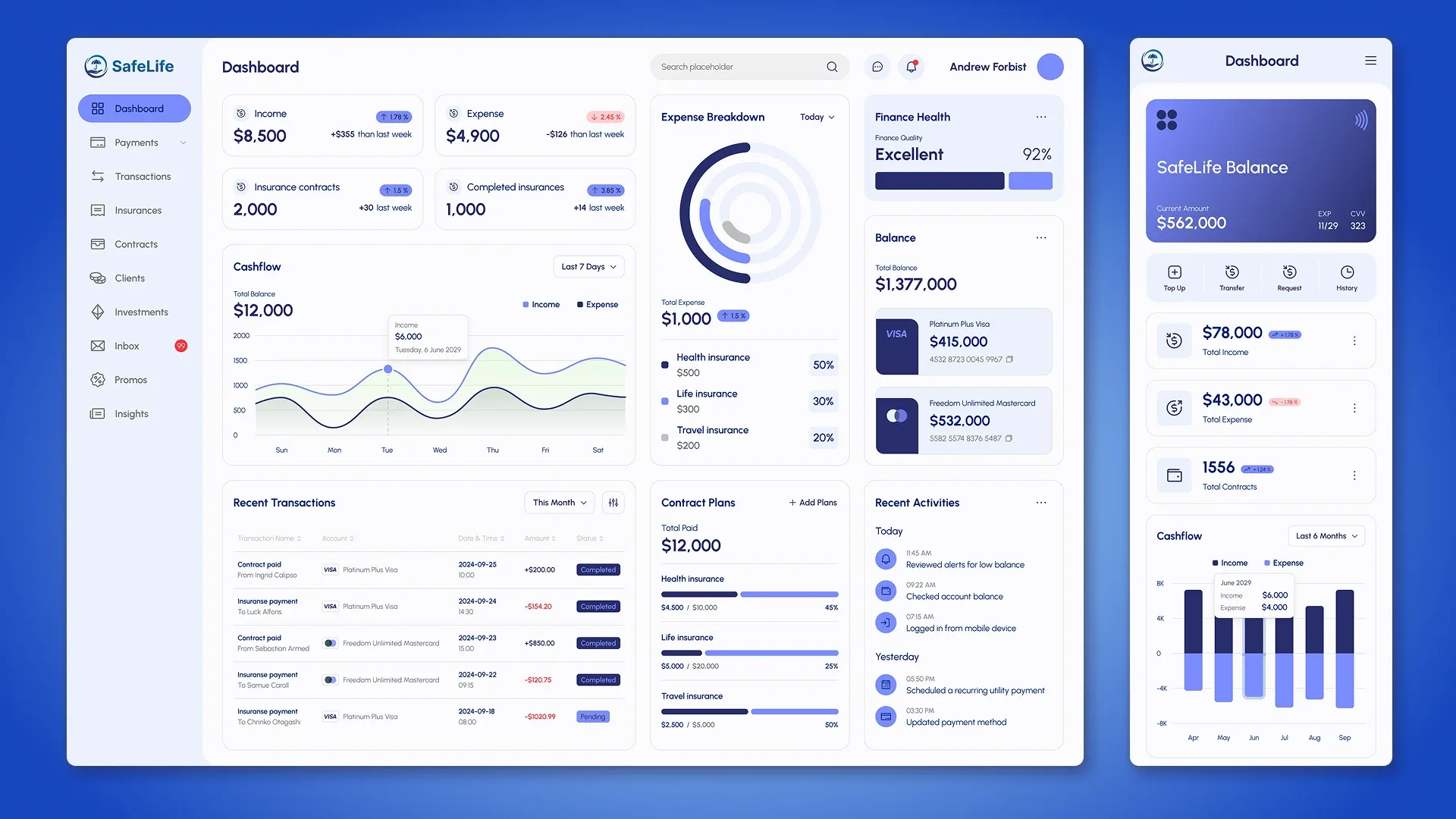
How does a CRM system for an insurance company identify the most valuable clients?
A CRM for an insurance company will become your intelligent assistant, accurately assessing the potential of each client. By receiving data from internal and external sources, it allows insurers to predict the profitability of each client and make informed decisions on retention, pricing, and service priorities.
The client's profitability assessment in the management system is formed taking into account several factors:
- the volume and frequency of insurance premiums, that is, all policies purchased by the client, their cost, validity periods and conditions;
- history of losses and payments for insurance claims, compensation amounts, frequency of incidents;
- duration of relationship with the company – the longer a client stays with you, the higher their LTV and the lower the likelihood of changing insurance companies;
- service costs – claims settlement, legal and consulting services involved in the process;
- Cross-selling potential. CRM evaluates which additional services or policies can be offered to a client based on their data and also records how willing the client is to purchase them.
Thus, the system can assign a client a personalized profitability or reliability rating, which is then used in automatic triggers. By segmenting potential buyers based on a comprehensive assessment or individual indicators, you can personalize your interactions with them – offering special terms, discounts, and informing them about new products and extensions to existing policies.

Possible integrations of the insurance business management system
The integration capabilities of a CRM for an insurance company largely depend on the type of insurance services provided. The flexibility of a custom CRM allows the system to be adapted to the specific needs of each insurance product.
- Life insurance in a CRM requires integration with government and medical registries, risk assessment modules, mailing services, and predictive analytics. The system tracks client life events (such as the birth of a child) and offers personalized insurance products.
- Health insurance requires data from clinics, laboratories, electronic medical records, and the E-health system, as CRM must track claims, automatically calculate coverage, and offer relevant policies to clients.
- Auto insurance in the CRM requires connection to the Ministry of Internal Affairs databases, technical centers, and claims assessment platforms. The system analyzes the car make and driving history, offers comprehensive/compulsory motor insurance quotes, and notifies about renewal dates.
- To automate policy issuance and interaction with developers, mortgage insurance requires CRM integration with banks, cadastral registers, real estate appraisal systems, and document processing services.
- Travel insurance in a CRM system involves connecting to booking services, tour operators, and regional risk assessment systems. It allows for quick policy issuance and tracking of validity periods based on the route and purpose of the trip.
- Corporate insurance requires CRM integration with HR, accounting, and internal ERP systems. This allows for issuing policies for groups of employees, accounting for benefits and limits, and automating internal approvals.


Stages of developing a CRM system for an insurance company
Developing a CRM for an insurance agency is a multi-stage, sequential process, in which every decision impacts the outcome. Let's look at the main stages of system creation.
- Analysis and goal setting
The first stage of development involves a detailed analysis of the insurance company's needs, current business processes, bottlenecks, and expectations for the system. It's important to consider the specifics of the insurance business: the large volume of documentation, the need for integration with external services such as electronic signatures and banking systems, and stringent data security requirements.
- Technical specifications
Based on the analysis, a technical specification is developed that describes the system requirements. It outlines key CRM functions: customer database management, document automation, integration with third-party systems, reporting, as well as performance and security requirements. The specification serves as the basis for subsequent development stages and ensures that the system meets all the client's criteria.
- Design and prototyping
Design and prototyping is the stage of visualizing the structure and functionality of the future system using interactive mockups. Prototypes of the main screens allow users to visualize and test the usability and functionality of the program, allowing for adjustments before development begins.
- UX/UI design development
UX/UI design development is the creation of the system's visual shell. It's important that the interface be equally intuitive for all users. The design should include elements that simplify working with the client base: policy creation, application processing, and reporting. The process of submitting and receiving an insurance policy should be as clear as possible, with clear instructions and a minimum number of steps. Insurance agents often work outside the office, traveling to claim sites and client meetings, so the CRM design must be responsive to ensure the program can be used on any device. The design should be consistent with the company's corporate style and look modern, harmonious, and original.
- Creating a program
Using programming languages and technologies, libraries, and frameworks, programmers write code for the frontend - the user interface – and the backend – the server component that processes requests and manages data. At this stage, they also integrate databases that store information about clients, policies, insurance claims, and payments. The developers' job is to ensure high performance of the CRM system and data security, as insurance companies handle personal information.
- Testing
This is a mandatory stage during which QA testers verify the functionality of all program functions, performance, security, and proper integration. They also evaluate the interface's usability and compliance with user requirements. The goal of this stage is to identify and fix errors before the program goes live.
- Release and implementation into the company's work
This stage includes installing the CRM on the company's server, setting up all integrations with external systems, and training employees. It's important that the system is implemented with minimal disruption and that the transition process is gradual. Detailed instructions are created and training is provided for users to ensure they can quickly get up and running with the new system.
- Project support and development
This phase includes resolving user issues and questions, updating the system, adding new features, mobile apps for agents, or integrations with new external services, and optimizing the program's performance. Regular security updates prevent data leaks and ensure compliance with new legal requirements.

Why should you order a CRM system development for an insurance company from AvadaCRM?
Automating insurance company operations isn't just a sign of digital transformation; it's essential for improving efficiency and competitiveness. CRM for an insurance company is a tool that makes customer interactions precise, efficient, and personalized, and makes insurance agents as productive as possible.
AvadaCRM is your reliable provider of custom CRM development services for insurance agents and comprehensive post-implementation support. We understand the importance of accuracy, security, and speed in the insurance industry, and we can offer a solution that fully meets your business's current requirements. Our CRM systems automate processes, increase agent productivity, and improve customer service. Ordering CRM development from scratch from us means investing in a powerful and flexible tool that will give you a sustainable competitive advantage in the insurance market.


FAQ
-
How long does it take to develop a CRM system for an insurance company?
The development timeframe depends on the functionality and complexity of the integrations. On average, a basic CRM version can be developed in 3–6 months, while a fully customized solution with advanced capabilities can take 6 months or more.
-
Is it possible to integrate CRM with banking and payment services?
Yes, CRM can be integrated with online payment systems, banks, and insurance brokers to conveniently automate payments, settlements, and document signing. This is especially important for the insurance industry, where transaction speed impacts customer loyalty.
-
How does CRM help automate the processing of applications and payments?
The system automatically verifies data, calculates policy costs, checks for outstanding balances, and sends invoices to clients. It also tracks the status of each application, notifying agents and clients of important changes.
-
How to protect customer data in the management system?
For the insurance industry, information privacy is always a priority. Modern security methods include data encryption, two-factor authentication, role-based access control, automatic backups, and protection from unauthorized access.
-
What reports can CRM generate?
The system allows you to generate reports on sales, application conversion, agent performance, policy renewals, insurance claims, and payouts. You can also create forecasts based on the collected data.
-
How does the system help forecast demand for insurance products?
The system analyzes customer behavior, purchase history, and external factors (such as seasonality) and, based on this data, predicts demand for various types of insurance, offering customers relevant services.
-
Is it possible to adapt CRM for different types of insurance?
Yes, the CRM can be configured for any type of insurance: auto, health, travel, corporate, mortgage, and more. The flexible structure allows you to add unique fields, calculation algorithms, and document templates.
-
How much does it cost to develop a CRM system for an insurance company, and what does the price depend on?
The price of such software depends on the set of functions, the complexity of integrations, the amount of customization, and additional services (mobile applications, analytics, artificial intelligence).
-
How does CRM help speed up insurance claim payments?
The program automates the insurance claim verification process, simplifies document management, notifies clients of payment statuses, and sends requests to banking systems. This reduces payment processing times and increases client confidence.
-
How does the management system reduce the number of errors in document processing?
Automated data entry, information validation, and templates help minimize errors. The system can also integrate with databases for automatic data upload.
-
Is it possible to connect a chatbot or voice assistant?
Yes, CRM can be integrated with chatbots and voice assistants, which will help clients obtain information about policies, submit applications, calculate insurance costs, and even initiate paperwork.
-
Why is a custom CRM for insurance companies better than ready-made solutions?
Ready-made CRM systems typically offer basic or universal functionality, so they require significant customization and additional investment. Custom products are fully tailored to the specifics of your insurance business – from complex premium calculations to automated actuarial models, integration with internal databases, registries, and specific APIs (e.g., MTIBU, NBU). Custom CRM development eliminates overpayments for unnecessary modules and licenses, fully complies with security and legal requirements, and ensures complete system ownership.