









CRM for maritime transport
In the shipping industry, customer service is always time-consuming: managing requests, preparing accompanying documentation and customs declarations, tracking cargo, and resolving ongoing issues. All this creates a high operational workload for staff, which can lead to a decline in service quality, which is unacceptable in a highly competitive environment.
By using a customized CRM system, you can optimize most of your company's internal processes through automation and ensure its sustainable development.
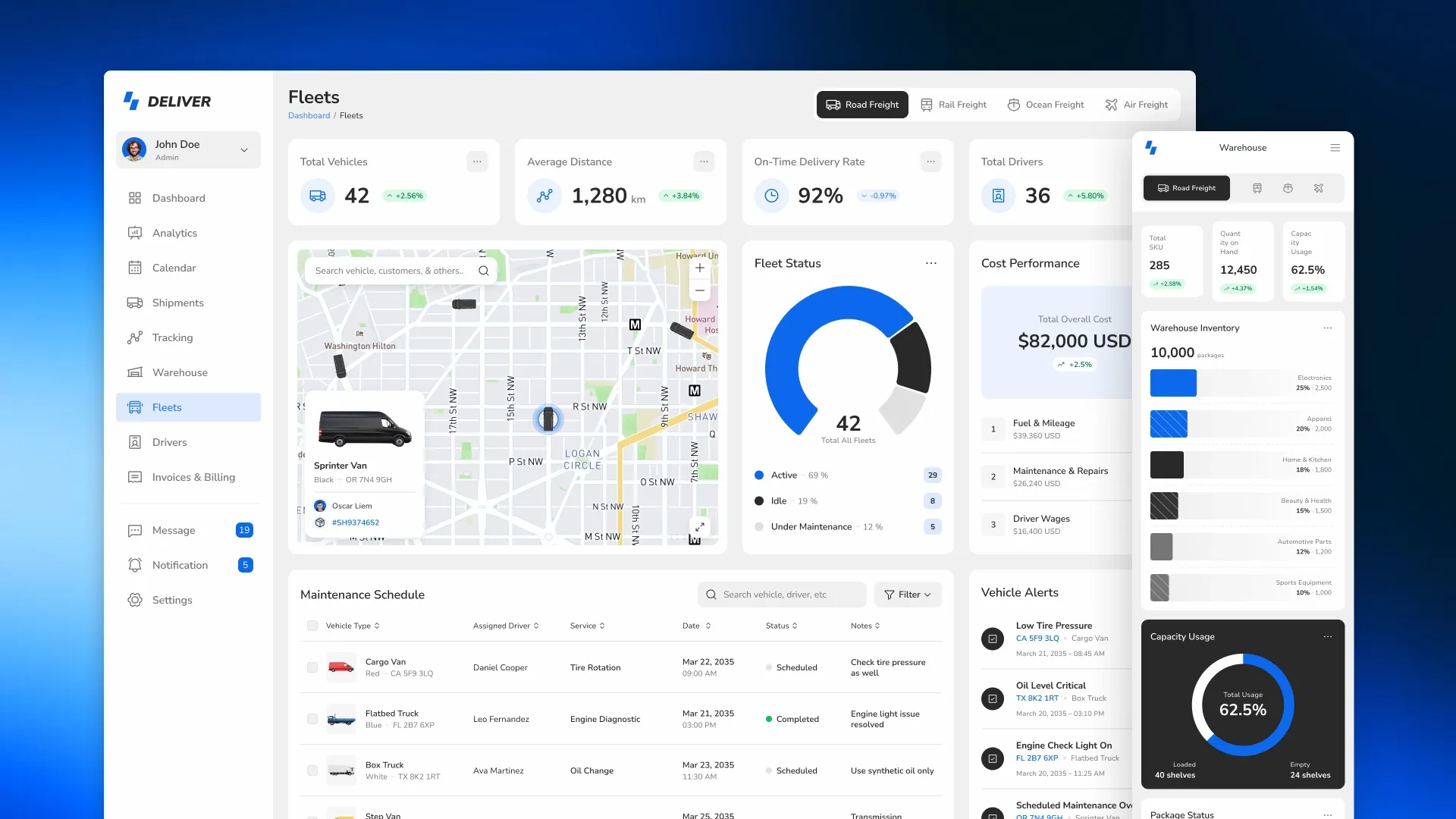
What tasks does CRM solve in maritime shipping?
Flexibility and security are essential in shipping CRM systems, so all system functions are developed individually, tailored to the needs of each individual company. General functional capabilities of such systems may include the following:
- Company structuring. Digital division of the business into departments and automation of interactions between them.
- Client database management. CRM stores a unified client database. Each client has a separate profile containing the entire communication history, a list of requests and their statuses, documents, and other important information, significantly simplifying communication.
- Monitoring staff performance. CRM tools collect reports on each employee's performance and allow for their effectiveness to be assessed.
- Order management. Maximum automation of cargo transportation order acceptance, tracking, and status changes.
- Digital document management. CRM can store all standard documentation—contracts, invoices, customs declarations, and more—allowing you to eliminate most bureaucratic processes and manage your document management digitally. This will improve the quality and speed of customer service.
- Integration of external services. CRM can be connected to various third-party services, such as online payment systems, telephony, and other tools that will make your company's work even easier and more convenient.
- Analytics collection. Up-to-date analytical data will allow you to evaluate your business's performance and identify the most promising areas for development.
How does the CRM development process work?
The maritime cargo transportation business is quite complex and involves numerous internal processes. Therefore, to create the most effective automation tools, it's crucial for developers to establish good communication with the client. To achieve this, we use the SCRUM methodology for development. The idea behind this methodology is that project development is carried out in short sprints, each with a specific goal and a limited deadline. This ensures that the client always knows what work is currently being performed and what the expected outcome will be. Beyond the methodology, there are also development stages.
Let's look at what work is being done at each of them.
Step 1. Collecting information
CRM development begins with research—our specialists need to determine the company's structure, its existing processes and their priorities, as well as the client's experience using similar systems. To answer these and other questions, we organize communication with the client's representatives.
Stage 2. Design and development of documentation
Design is considered a fundamental stage in CRM development, during which specialists lay out the project's functionality and architecture. A high-quality and well-thought-out prototype significantly reduces risks, optimizes the development process, and reduces the time it takes to create a high-quality product. Design creates:
- interface mockups;
- schematic visualization of CRM modules;
- summary table of functionality;
- The mathematics of the project is described.
Our specialists also record demo videos for clients, detailing the logic behind all the features. This allows them to understand how their CRM will look and function even before they write a single line of code. Simply put, a prototype is the foundation of the project, upon which the entire development and testing process is built. Therefore, we devote considerable time to this stage.
Stage 3. Design development
It's important for a CRM system's interface to be user-friendly and intuitive. This will simplify staff training and minimize the likelihood of errors during operation. This is critical for shipping businesses, as any error can be costly.
To achieve the highest quality results, such CRMs are custom-designed. With this approach, all interfaces, tables, graphs, and other elements are hand-drawn, taking into account the system's functionality.
Stage 4. Programming
Technical development of a CRM is considered one of the most complex stages. It can be divided into two components:
- Frontend. This is the client-side part of the system. It is created in strict accordance with the previously approved design and ensures a comfortable user interaction with the server. Frontends for web applications can be built using HTML/CSS/JavaScript or Vue.js/React.js frameworks. For mobile applications, cross-platform technologies such as Flutter/Dart or native technologies can be used: Swift for iOS, and Java/Kotlin for Android.
- Backend. This is the reverse, or server-side, part of applications, where all data is processed and stored. Backend development in web applications typically uses Python/PHP/Node.js or frameworks such as Django/Flask/Yii2/Laravel. Mobile and desktop applications may also use C++ in addition to this stack.
Step 5. Testing
After developing the functionality, it's important to ensure it works correctly. To do this, QA engineers are involved in the project, performing comprehensive testing of the CRM system.
Stage 6. Technical support and development
During the first few weeks of using the CRM in real-world conditions, users may encounter unexpected errors. In each such case, the issue is investigated and promptly resolved by the developers through technical support. Importantly, after the release, you can continue developing your CRM by releasing new patches. This way, it will grow alongside your business and always meet its needs.

Developing a CRM for shipping in AvadaCRM
A customized CRM will help your company automate internal processes and establish more effective customer interactions. It will streamline employee collaboration and enable a complete digitalization of document flow, opening up new opportunities for business growth.
AvadaCRM has extensive experience developing CRM systems for logistics and freight transportation. When implementing such projects, we fully immerse ourselves in the client's business, studying their individual processes and needs, and then finding optimal technical solutions.