









CRM for taxi service
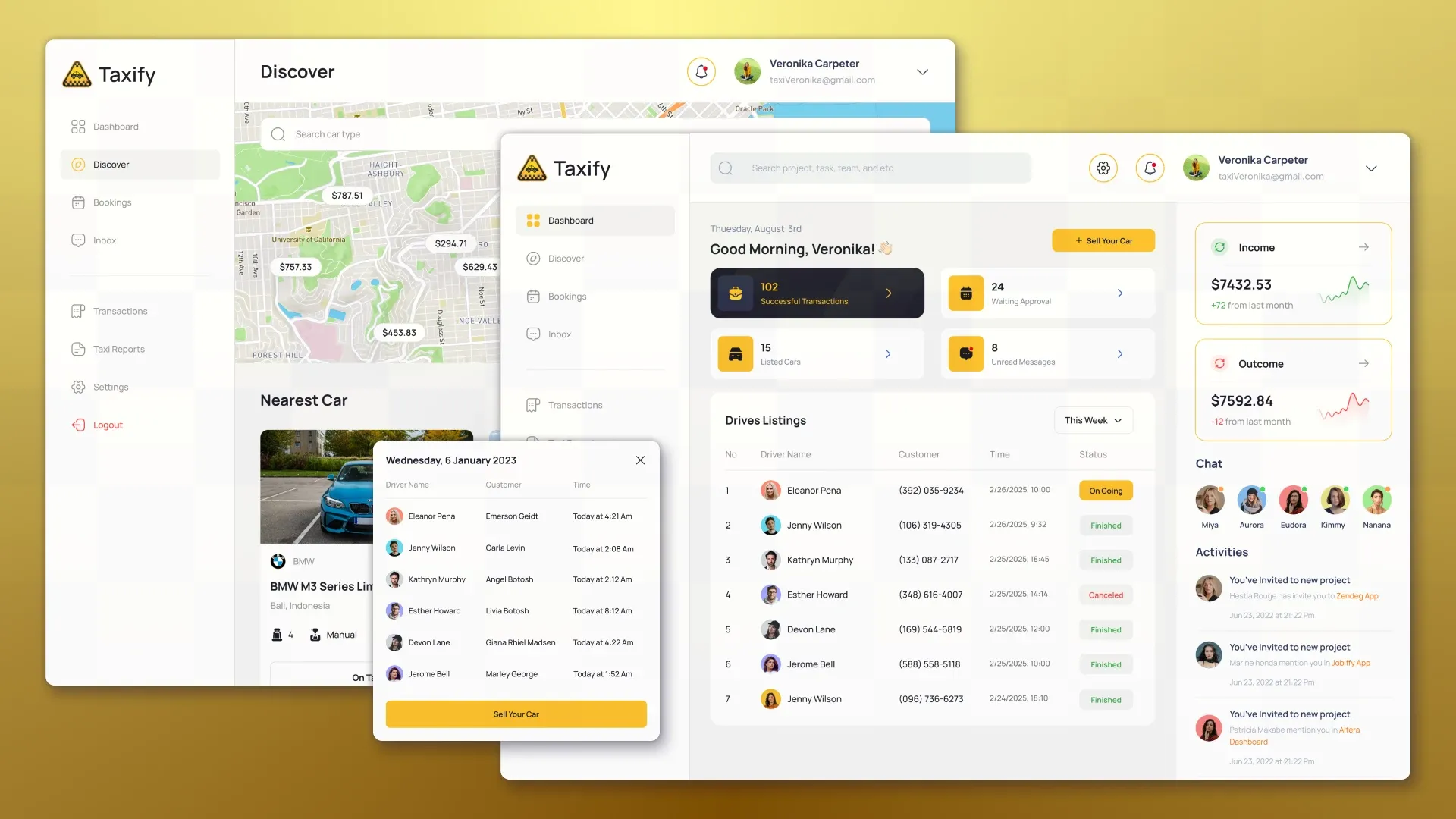
The modern passenger transportation market is becoming more and more dynamic. Customers expect instant service, drivers strive for stable earnings, and fleet owners strive for transparent and efficient management. Fleet automation makes it possible to optimize workflows, minimize costs, improve the quality of service and increase business profitability. Ordering the development of CRM for taxi in AvadaCRM is a step that will help make your business the pulse of your city.
What is a CRM system for a fleet?
CRM for the fleet is a taxi program that automates all the key processes of the work of drivers and the dispatching service. It includes modules for order management, trip distribution, analytics, driver and vehicle accounting, financial control, etc. This is your personal control center that ensures the smooth operation of the passenger transportation service.
The main problems of taxi fleet management
Taxi fleet owners and dispatch services face a number of problems on a daily basis that complicate effective business management:
- Inefficient distribution of orders leads to delays, customer dissatisfaction and loss of orders. Without automation, it is difficult to take into account the current traffic congestion, it is impossible to react quickly to changes in the situation on the roads and redistribute orders. All this leads to suboptimal routes and an increase in the lead time of order fulfillment. as the other is overloaded.
- Inadequate monitoring of order fulfillment, scheduling, customer service, and revenue can lead to time tracking issues (especially with piece-rate payments), reduced customer satisfaction, increased complaints, and reputational risks.
- Difficulties with monitoring the fleet and the technical condition of vehicles, planning maintenance and accounting for fuel costs lead to an increase in operating costs.
- Lack of customer feedback, making it difficult to respond quickly to complaints and feedback, personalize service, and implement loyalty programs to retain customers.
- Security issues. Checking drivers, monitoring trips and controlling cars require significant resources. At the same time, the lack of a transparent system for checking drivers and analyzing their ratings can lead to a deterioration in the quality of service and an increase in the accident rate.
- The heavy workload on operators due to manual order management increases the likelihood of errors and slows down order fulfillment. This reduces the overall capacity of the taxi service and makes customers wait too long.
- Lack of analytics. Without data collection, it is impossible to predict demand and adjust tariffs, it is difficult to predict when and where there will be a peak in orders and identify weaknesses in the work of the service.
- Difficulties in accounting for income and expenses (especially with a large number of drivers and orders) lead to delays in payments to drivers, dissatisfaction and staff turnover.

CRM system functions for fleet and taxi
Fleet management software is a powerful tool that allows you to comprehensively manage all aspects of your business: from taking orders and assigning drivers to analyzing performance and customer interactions.
- Automation of the taxi dispatching service. Thanks to the intelligent trip optimization system, the program for taxi dispatchers allows you to manage orders in real time, automatically distribute orders between drivers, taking into account their location and availability.
- Driver and car management. The program for the taxi fleet helps to monitor the work of drivers, the technical condition of the fleet and controversial situations with passengers, as well as plan the maintenance of transport.
- Interaction with customers. The program for taxi operators provides quick and convenient communication with customers, prompt creation and editing of applications, as well as collection and analysis of reviews.
- Financial accounting. Taxi service CRM is the automation of payments to taxi drivers, as well as accounting for income and expenses.
- Analytics and reporting. For owners of transportation businesses and taxi services , CRM provides detailed analytics that allow them to make informed management decisions.
- Integration with external services. The program for accounting for the taxi fleet can be synchronized with:
- government services to check driver's licenses, insurances and history of violations, tax accounting and reporting;
- Partner programs of hotels, restaurants, and other companies to provide joint services and discounts.
- corporate clients to organize the transportation of employees;
- smart city systems: platforms for paying for parking and other city services, traffic monitoring systems and traffic jam forecasting;
- payment systems (LiqPay, PayPal, Portmone) for online payment;
- GPS services (Google Maps, Waze) for tracking cars and calculating the cost of the trip;
- SMS messaging services to notify customers;
- insurance companies;
- accounting programs (1C, SAP) for automating financial accounting;
- law enforcement agencies in emergency situations.


Advanced features of the program for taxi services
Thanks to innovative technologies, the taxi program can provide advanced options and opportunities for both business owners and drivers and passengers.
Enhanced security
- Car tracking systems for taxis using integration with cameras in the car to monitor the safety of passengers and drivers, recording and storing video materials to resolve disputes.
- Panic buttons and warning systems for automatic notification of the dispatching service and law enforcement agencies allow drivers and passengers to quickly report emergencies and threats to life.
- Driver monitoring systems can detect fatigue and monitor driving styles, preventing accidents.
Advanced options for clients
- The ability to choose a car of a certain class (economy, comfort, business) and additional services (child seat, transportation of animals), as well as choose a driver.
- Loyalty programs and bonuses: accrual of travel bonuses and recommendations, personalized discounts and offers.
- Integration with messengers and social networks makes it possible to order a taxi through popular messengers and receive notifications about the delivery of a car.
Use of artificial intelligence
- Use artificial intelligence to optimize routes, predict demand, and personalize service.
- Chatbots to automate support and prompt order processing.
Cybersecurity and data protection
- Data encryption – when developing a CRM system for taxis, our specialists use modern encryption protocols to protect the personal data of customers and drivers.
- Two-factor authentication provides an additional layer of protection for operators, drivers, and administrators.
- A flexible system of access rights allows you to restrict information for different users.
- Regular system updates ensure security by eliminating vulnerabilities and updating software.
What are the advantages of taxi service automation?
- Optimizes the work of the dispatch service - the program for taking taxi orders selects the best options for a certain route, reducing the processing time of orders and the duration of trips, minimizing the likelihood of errors.
- Distributes orders, instantly transferring calls to drivers without the human factor.
- Controls the cost of fuel, car maintenance, drivers' salaries and other operating expenses, helping to effectively manage finances.
- Reduces operator errors, reduces their workload, and increases productivity.
- It allows you to implement loyalty programs, personalized offers, and analyze user reviews.
- Increases profits through demand analysis and dynamic pricing.
- Improves the quality of service through quick response to customer requests and a personalized approach, since customer loyalty depends on the convenience of ordering, transparency of tariffs and the speed of car delivery.

How a CRM system for taxis simplifies the work of taxi service employees
A CRM program for fleet management increases the efficiency of all business participants:
- Drivers receive orders automatically, without having to wait for a call from the dispatcher. The driver's app with navigation and other useful features makes work easier – it shows the route, the cost of the trip and customer reviews. The program for a taxi dispatcher allows you to honestly distribute orders and take into account the driver's rating. Transparent accounting of earnings with automation of payments increases motivation.
- Dispatchers see all drivers on the map through a user-friendly interface for managing orders, can quickly respond to problems and changes in the situation on the roads, and manage orders in real time. The fleet software reduces the workload of operators by automatically distributing orders.
- Fleet owners and managers can make informed management decisions. Reporting and analytics help you control finances, fuel costs, fleet utilization, and driver efficiency.
- Customers can use the taxi program to order a car in a few clicks, wait less time for a taxi to arrive, keep in touch with the dispatcher, use the loyalty program, track the route and leave reviews.
Stages of developing a CRM system for transportation companies
Automation of passenger transportation is a long and consistent process that takes place in several stages.
1. Analysis and definition of goals
At the first stage, the team of analysts immerses themselves in the specifics of the company's work, studying the current processes: the number of vehicles, methods of accepting orders, types of transportation (urban, intercity, corporate), the load on the dispatching service and existing software solutions. Identify the key problems that the automation of the taxi dispatcher can solve: delays, suboptimal machine distribution, customer losses. Key performance indicators are also determined: submission time, number of completed orders, customer satisfaction level.
2. Terms of reference
Based on the analysis, a detailed technical specification is formed. It defines the mandatory functions: automation of the taxi dispatch service (distribution of orders taking into account traffic congestion), driver motivation system, integration with GPS trackers, mobile applications for drivers and customers, payment systems, fuel cost control modules, fleet maintenance planning, etc and the cost of the project.
3. Design and prototyping
Based on the terms of reference, they develop the logic of CRM for the fleet, model business processes – for example, the distribution of orders between drivers, tariff management, route efficiency analytics. Develop the architecture of the taxi program for drivers and create interactive interface prototypes: maps displaying cars, an order management panel, a driver's personal account. Using tools such as Figma, Sketch and Moqups visualize the future program for a taxi, demonstrate it to the customer and make adjustments.

4. Development of UX/UI design
Designers create a convenient and intuitive interface that takes into account the specifics of the work of dispatchers and drivers. For example, a minimalistic interface is being developed for drivers that does not distract from the road, and an informative panel with all the necessary data is being developed for dispatchers.
5. Writing code
Programmers implement the server and client parts of the CRM system for the fleet. Front-end development includes the creation of a web interface for dispatchers, mobile applications for drivers and clients using the frameworks Flutter, React Native, React, Angular or Vue.js. The backend part is created using Python, Node.js, Java, PHP. These are the development of server logic, database management (PostgreSQL, MongoDB), API implementation for integration with external services.
6. Testing
An important stage is testing all components of CRM for taxis in real conditions: peak hours are simulated, the operation of the system is checked with a large number of orders, GPS tracking is tested in different areas of the city. Particular attention is paid to security testing: protecting customer data, preventing unauthorized access.
7. Release and implementation
After successful testing, the system is deployed on servers and gradually introduced into operation. Dispatchers and drivers are trained, instructions and consultations are provided.
8. Support and development of the project
Any CRM system for a taxi needs technical support: error elimination, system updates, consultations. Developers collect feedback from users, analyze data and make changes to improve the system, add new features – for example, a loyalty program, integrations with messengers, analytics for demand forecasting.
What are the risks of implementing a CRM program for taxi companies
Some taxi fleet owners are in no hurry to order a CRM program, fearing the possible difficulties associated with the implementation of new software. In fact, all the risks of CRM implementation are easily controlled, and the benefits far outweigh the possible difficulties.
- High cost of implementation.
Taxi service owners think that fleet automation is expensive. However, fleet control software reduces operating costs, optimizes routes, and saves fuel. In the long run, a taxi CRM pays off by increasing profits.
- Difficulties with staff training.
Some employees are afraid of not being able to cope with the new software. Our specialists provide technical support for the system and develop an intuitive interface that requires minimal training time.
- Resistance from drivers.
Drivers may feel that CRM transparency will limit their freedom. In fact, the system makes their work more convenient: orders are distributed honestly, there is no need to wait for calls from dispatchers, and the rating allows you to get more profitable orders. For drivers, the management system is a tool to increase earnings.
- Technical failures and software dependence.
A high-quality CRM is developed with fault tolerance in mind, and server capacities ensure stable operation. Local solutions that do not depend on Internet access are also possible.
- Long implementation process.
The individual development of a CPM for a taxi lasts several months, and the integration process takes place in stages so that you can switch to the new system gradually, without downtime.


What kind of program is needed for a taxi - ready-made or custom-made
Ready-made CRM solutions for taxi at first glance seem to be a convenient and fast option, but in fact, they lose out to individual systems:
- offer standard functionality that often does not meet the unique requirements of the company;
- are not always compatible with the services and platforms already in use, which creates additional difficulties during implementation;
- Many solutions work on a subscription basis, which leads to constant costs, as well as dependence on the software vendor;
- have limited data security as they reside on shared servers and cloud platforms;
- Not flexible enough – as the business grows, ready-made solutions may not be able to cope with the increase in load, as a result, you will need to switch to other software.
Unlike template and universal automation systems, individual CRM development for a taxi fleet allows you to create a system that will take into account all the features of your company, including unique pricing models, features of interaction with drivers and customers.
Custom development makes it easy to scale the system as your business grows, implement new modules, and integrate with external and internal services. Your own Taxi program for drivers and dispatchers contains only those features that your business needs and contributes to its growth.
Why is it better to order the development of a taxi program from AvadaCRM?
AvadaCRM provides services for the development of CRM systems for a full-cycle fleet: from creating from scratch to scaling existing solutions. We understand that every business is unique and help create tools that solve your problems as efficiently as possible, increase productivity and ensure the growth of your business. Taxi and fleet automation will help make your company a leader in the passenger transportation market, thanks to powerful and flexible tools for management and development.


FAQ
-
Is it possible to integrate taxi software with cameras in cars?
Yes, the system supports integration with dashcams and cameras in the car. This helps to control the behavior of drivers, resolve disputes with passengers and ensure the safety of trips.
-
How does the CRM help reduce fuel costs in a taxi?
The program analyzes fuel consumption, compares real consumption with standard consumption, tracks routes and recommends the best ways to minimize costs. It is also possible to connect to refueling control systems and fuel cards.
-
Does the taxi fleet software support automatic driver matching?
Yes, the system can automatically select a driver, taking into account his rating, experience, geolocation and current load. This reduces waiting times for customers and improves fleet efficiency.
-
Is it possible to connect CRM to state registers and driver verification services?
Yes, there is a possibility of integration with government databases to check driver's licenses, criminal records, insurance events and fines, which increases the safety and reliability of the fleet.
-
Can a program for taxi services predict the demand for services?
Yes, CRM can use historical data, weather, events, and time of day information to predict peak loads and recommend car distribution to the most popular areas.
-
How does CRM help to monitor the technical condition of cars in a taxi service?
The system automatically reminds about maintenance, keeps a history of repairs, reports malfunctions and can be integrated with car sensors to monitor the condition of the engine, brake system and other key components.
-
Does the CRM for the fleet support car sharing and car rental?
Yes, the system can manage not only the taxi fleet, but also rental and car-sharing services, allowing you to control access to cars, tariffs, payment and monitoring of vehicle usage.
-
How much does it cost to develop a CRM system for a taxi?
The cost of a taxi program depends on many factors: functionality, complexity of integrations, the need for customization, and the level of security. It is important to analyze the needs of the business so that the price of the taxi program corresponds to its capabilities.
-
Is there a program for a taxi without a dispatcher?
Yes, such a program uses algorithms that automatically find the nearest available driver, assign orders and optimize routes.
-
Is the taxi dispatcher suitable for a small town?
For small towns, it is important that the CRM for the taxi fleet dispatch is convenient, inexpensive and easy to configure for local characteristics. The optimal solution is an individual system with basic functions.