









CRM for traffic arbitrage
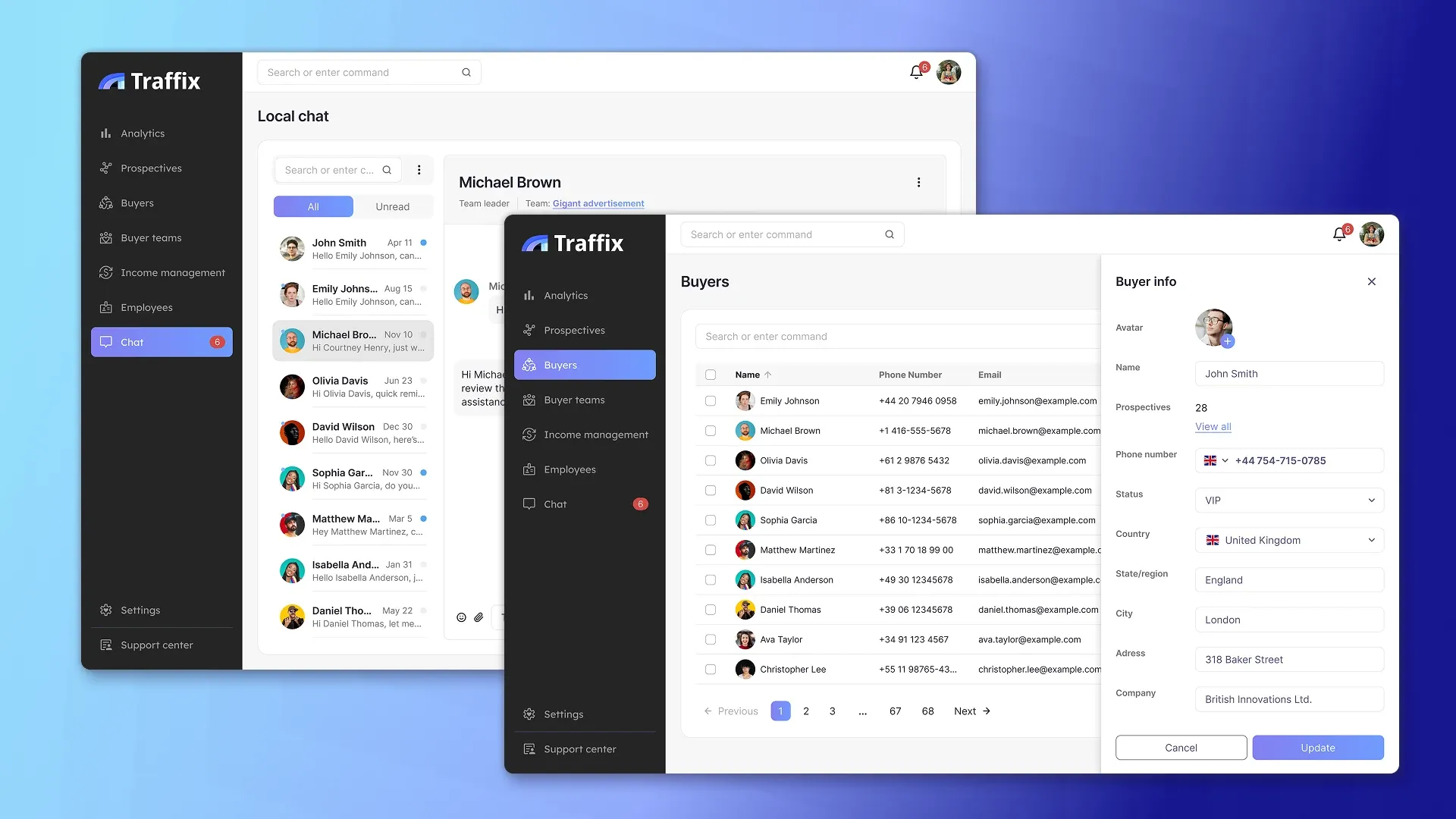
In affiliate marketing, profits depend on the speed of decision-making, transparency of processes, and accurate analytics. In a highly competitive environment, traffic arbitrage automation can be a key scaling factor. A specialized CRM system for arbitrageurs helps to structure work with offers, automate payments, collect analytics in one place, and promptly respond to market changes.
AvadaCRM offers the development of custom CRM systems for arbitration teams, CPA networks, and affiliate programs. Our solutions help you manage traffic, automate routine processes, and increase your ROI.
What is a CRM system for traffic arbitrage
CRM for traffic arbitrage is a management system designed taking into account the needs of webmasters, the specifics of CPA networks and affiliate programs. Such platforms help to manage traffic flows, automate routine processes, and analyze conversions in real time.
CRM development for an arbitrageur solves many key tasks, for example:
- centrally manages offers and advertising campaigns;
- provides flexible control of traffic and conversions;
- automates routine processes, for example, payment checks, lead tracking, budget allocation;
- gives access to improved analytics and ROI forecasting;
- provides data protection and access control.
Standard CRM systems built to manage sales or customer base are not suitable for arbitrage business. In this area, you need a program that is integrated with trackers, advertising platforms, CPA networks, and payment systems.
Why do arbitrageurs need automation?
An effective CRM for arbitrage covers the entire cycle of working with traffic: from integration with advertising platforms to automation of financial transactions. Depending on the customer's goals, the system can perform the following functions:
- automatically collect and analyze data on offers from CPA networks and advertising accounts (Facebook Ads, TikTok, Google Ads, MGID, etc.);
- integrate with trackers (Voluum, Binom, RedTrack) to track leads and events, detailed conversion analysis;
- calculate payments to webmasters and control budgets, automate billing, and take into account commissions;
- monitor offers in real time, analyzing the main metrics (EPC, CR, ROI);
- automate A/B testing and creative selection;
- manage offers and traffic sources – for example, filter by EPC, CR, geo, categories, set up offer rotation rules;
- provide a flexible analytics system using dashboards and graphs, processing large amounts of data;
- include anti-fraud mechanisms (anti-fraud systems) to identify suspicious activities, bots and check the quality of traffic;
- provide flexible access settings for webmasters, managers, administrators.
In traffic arbitrage, the speed of work determines the profitability of campaigns. CPA marketing automation allows you to reduce errors, speed up information processing, and effectively manage budgets.
When Arbitration Teams Need a CRM System
The arbitrage business does not always need specialized software at the start of work, but with the growth of data and campaigns, it becomes difficult to manage processes manually. The use of CRM for traffic arbitrage is justified when:
- large amounts of data and campaigns require automated control;
- it is important to quickly analyze indicators and make decisions;
- requires centralized control of costs and payments to webmasters;
- Integration with advertising platforms, trackers, analytical tools is required.
A CRM system is needed by arbitrage teams and solo arbitrageurs who work with multiple CPA networks and advertising sources at the same time.


Stages of developing a CRM system for arbitrageurs
CRM development is a multi-step process where each step affects the final result.
1. Analysis and identification of needs
At the first stage, analysts study how the arbitrage team works: what traffic sources are used, which CPA networks are connected, how costs and conversions are controlled. To form a CRM concept for CPA marketing, it is important to identify weaknesses and processes that can be automated, identify the necessary functional modules and integrations.
2. Terms of reference
The terms of reference prescribe the key functions of the system: integrations with advertising platforms and trackers, offer management mechanisms, analytical tools, financial modules, and anti-fraud systems. Technology, development stack, and system architecture are also defined.
3. Design and prototyping
At this stage, the system architecture is developed, databases are designed, and a system of roles and access rights is formed. Then interactive prototypes of the system are created, demonstrating the logic of the system. With the help of interface prototypes, user scenarios are tested together with the customer.
4. UX/UI design development
Designers develop a functional, intuitive and user-friendly interface adapted to different devices and work with a large amount of data, intuitive navigation, data visualization in convenient dashboards and reports, color accents for key metrics, etc.
5. Program code development
The stage of writing program code consists of two parts. The backend is responsible for data processing logic, API integrations with advertising systems, working with trackers, calculating payments, and controlling the budget. The frontend provides a user-friendly interface for working with CRM, high page loading speed, and the implementation of dashboards with dynamic data. For the frontend part, tools such as React, Vue.js or Angular are used, ensuring fast loading of interfaces. The backend is implemented using Node.js, Python, or PHP. They also configure API integration, security system, and data caching.
6. Testing
Before launching CRM traffic arbitrage programs, they check its compliance with the requirements, API operation, scalability, resistance to large volumes of traffic, security, correctness of analytics and metric calculations, and test user scenarios. Comprehensive testing includes checking the software product for errors, as well as load and unit testing.
7. Release and implementation
After successful testing, the system is deployed on the customer's server or in the cloud space and integrated into the team's workflows, and user training is conducted.
8. Support and development of the project
After launch, CRM for an arbitrageur needs technical support, implementation of new features, integration with new advertising platforms, trackers, and affiliate programs according to market changes.

Why is it better to order the development of a CRM system for traffic arbitrage in AvadaCRM?
We provide CRM development and scaling services for CPA businesses that will become your competitive advantage by providing data centralization, process automation, and in-depth analytics. Thanks to our approach, you get a program that not only meets the current needs of your business, but grows with it. An individual management system for arbitrageurs from AvadaCRM will provide transparency and control over each stage, take care of all routine tasks, leaving you time to search for promising offers and new connections.


FAQ
-
How much does it cost and takes to develop a CRM system for an arbitrageur?
The timing and price of CRM for traffic arbitrage depend on the complexity of the project, the number of users, integrations and modules, and individual requirements. Based on what the customer needs – a basic or advanced solution, all stages of development will take from three months or more
-
How does individual technology differ from boxed CRM solutions?
Unlike ready-made solutions, an individually designed system takes into account all the processes of your business and is ready to scale.
-
Is it possible to create your own reports and dashboards in CRM?
Yes, CRM provides flexible opportunities for creating user reports and dashboards, allowing you to visualize data in a convenient format.
-
How does CRM help manage relationships with affiliate networks?
Integration with affiliate networks enables automatic data exchange, payout monitoring, and regulates partnerships.
-
How does the app help optimize your ad spend?
CRM provides detailed analytics from ROI and other key metrics, allowing you to identify underperforming campaigns and optimize costs.
-
Can CRM be used to manage multi-channel campaigns?
Yes, it is possible to develop a CRM for an arbitrage team that will help manage campaigns with different traffic sources, providing unified control and analytics.
-
How is data security ensured?
To do this, they use advanced security methods, including data encryption, two-factor authentication, access rights delimitation, and regular backups. In addition, the CRM is protected from DDoS attacks and unauthorized access – this ensures the security of financial and customer data.
-
Is CRM good for solo arbitrageurs?
Yes, the system can be adapted to any business – from mini-teams to large arbitration agencies. For solo arbitrageurs, compact but functional solutions can be developed.