









CRM for travel agency
The tourism business is dynamic: rapidly changing trends, unstable demand, seasonality, and high levels of competition. In this chaos, leads disappear, bookings are duplicated, and clients receive outdated information. To operate successfully, it's essential to automate processes, quickly process customer requests, analyze the effectiveness of marketing campaigns, personalize offers, and maintain convenient booking records. All this is possible with a CRM for a tourism company.
Are your managers still searching through hundreds of contacts, simultaneously fielding calls, and trying to remember to enter new leads in Excel? Ordering CRM development for your tourism business from AvadaCRM means putting management clutter to rest and taking your business to the next level.

What is CRM for travel companies?
CRM for travel agencies is a customer relationship management system that helps organize all business processes of a travel agency: from the first contact with the client to the completion of their trip and subsequent performance analysis.
Imagine: your travel agency receives dozens of inquiries daily. Managers are torn between calls, social media, email, and instant messaging, trying not to forget a single client. Bookings are lost, clients don't receive timely responses, and marketing campaigns are running in the dark. The result is lost revenue, a damaged reputation, and increased stress. This is exactly how a company operates that still hasn't automated its workflow with a travel CRM.
CRM system functions for travel agencies
A CRM system for a travel agency is not just an application, but a reliable tool that can handle numerous tasks, such as:
- Formation and management of a client base – storage of contact information, interaction and booking history, preferences and reviews, client segmentation according to various criteria;
- Booking accounting and management – integration with hotel and airline booking systems, tour search, automatic order confirmation, synchronization with calendars;
- Marketing activities – creation of email and SMS newsletters, personalized offers, analysis of the effectiveness of marketing campaigns;
- detailed reporting on company performance, sales analysis, and customer behavior;
- financial control – automated invoicing, payment accounting, integration with banking services;
- Automate communications through integration with chatbots, SMS messaging, and email campaigns.


Benefits of a travel agency management system
CRM systems in tourism create numerous opportunities for effective business management:
- automate business processes (request accounting, booking management, payment control), allowing managers to work faster, minimizing errors, and ensuring fast service for clients;
- improve service levels and customer satisfaction by providing instant access to customer interaction history, prompt resolution of issues, and a personalized approach based on the customer's request history and preferences;
- increase sales through personalized offers, automatic travel reminders, and effective lead management;
- integrate with external services – payment systems, booking services, social networks and support services;
- optimize staff work – thanks to CRM, each employee clearly knows their tasks, and management can track and control the implementation and effectiveness of work;
- reduce costs by automating routine tasks, optimizing work processes and reducing the risk of errors;
- Improve analytics with detailed sales reports, tour demand analysis, and seasonal forecasting. Travel agents can track sales trends, plan promotions, adjust promotional strategies, identify weaknesses, and make informed decisions.
After implementing CRM in the tourism industry, companies operate quickly, confidently, and error-free. All requests are collected in a single interface, managers can see the history of interactions with each client, and automated processes reduce the time spent on routine tasks. Competition in the tourism industry is fierce, and those who lag behind in implementing digital solutions are doomed to lose clients.

CRM for tour operators and travel agencies: what's the difference?
Despite their shared goal of selling tourism services and providing high-quality customer service, tour operators and travel agencies operate under different business models, which directly impacts the functionality of tourism business management systems.
CRM systems for tour operators focus on managing the full cycle of creating and selling tourism products. Key features of such programs include:
- integration with global booking systems for automatic creation of tour packages – for example, Sabre, Amadeus, Galileo, etc.;
- control of accommodation, transfers, excursions, insurance, as well as other related services that form a complete tourist package;
- Profitability analysis of areas allows us to evaluate the effectiveness of products and promptly adapt offers;
- B2B partner and agency network management – tour operators often have hundreds of partners across the country or abroad. CRM allows for centralized management of relationships with them, monitoring contracts, commissions, and quotas.
A CRM system for a travel agency is more focused on working with the end client and selling ready-made tours, so its functionality is typically as follows:
- Request collection and sales automation – quick booking, cost calculation, CRM forms on the website, integration with messengers;
- Purchase history and repeat sales – the system stores customer preferences, prior trips, and generates personalized offers;
- modules for email and SMS mailings to retain customers and launch seasonal or thematic campaigns;
- Manager rating and control, KPI and workload assessment, automatic application distribution.
The choice of a CRM system for tourism depends on the company's role in the sales chain. Tour operators require broader functionality and a flexible system with a focus on B2B, logistics, and product management. Travel agencies prefer a less complex program focused on quickly closing deals and driving repeat sales.
How CRM Improves Tourist Service
A CRM system for a travel agency becomes the foundation for impeccable customer service at every stage of interaction – before, during, and after the trip.
Before the trip, the program can:
- send automatic reminders about upcoming trips, the need to obtain a visa, medical insurance, and prepare documents;
- create individual tour selections based on preliminary requests and client wishes;
- Integrate with instant messaging apps and email, helping managers maintain constant contact with tourists and send important information, documents, and reminders via a convenient channel.
During a client's trip, the tourism CRM system:
- provides real-time support – thanks to chats integrated into the CRM, tourists can ask for help at any time;
- updates information and reminds about transfers, change of guide, excursion, departure time, etc.;
- Stores documents (electronic vouchers, tickets, routes) in one place and provides access to them from any device.
After your trip, travel agency software helps you:
- collect feedback – send out questionnaires, create surveys or request for feedback;
- analyze the level of customer satisfaction, loyalty and trust and develop a strategy for customer retention;
- Encourage repeat sales by offering relevant destinations or bonuses for subsequent bookings based on customer behavior.

Why custom development is better than ready-made CRM for travel agencies
Ready-made solutions have limited functionality and don't address the specific needs and requirements of a particular company. Custom CRM development for a travel agency allows you to create a highly customized management system with the following advantages:
- flexibility and scalability;
- absence of unnecessary modules;
- integration with any services;
- data protection and access control.
Custom CRM development for a travel agency is an investment in the future of your business. This system will grow with your company, adapting to its new needs and market conditions.
Technologies and tools for developing CRM for travel agencies
Modern technologies and tools are used to develop a CRM system for tourism:
- programming languages for the backend: Python (Django), Node.js, PHP (Laravel);
- for frontend: React.js, Vue.js;
- databases: PostgreSQL, MySQL, MongoDB;
- for integrations: airline APIs, payment systems, mapping services;
- cloud solutions: AWS, Google Cloud, Azure;
- security: SSL, OAuth, two-factor authentication;
- for design and prototyping: Moqups, Figma, Sketch, Adobe XD, Axure RP;
- Design development: Figma, Adobe Photoshop, Illustrator.


Stages of CRM development for a travel agency
Developing a CRM system for a travel company is a complex, integrated process aimed at creating a global digital environment. Therefore, achieving the best results requires consistency and a professional approach to each stage.
Business process analysis
The first stage of development is devoted to studying the specifics of the tourism business, identifying the key problems the product should solve, and analyzing competitors and current automation tools. Developing a CRM requires detailed knowledge, such as the key stages of booking - from the initial customer inquiry to booking confirmation and after-sales service; and the format of interaction with tour operators - how information about tours, prices, availability, etc. is exchanged.
At this stage, existing management tools are also assessed. Key questions include: how is customer information stored, what tasks are performed manually, what data is lost, and which processes take too much time.
Development of technical specifications
The specifications describe all modules, integrations with third-party services, and user scenarios. Typically, the components of a CRM for a travel agency are as follows:
- customer management module, where detailed information about customers, their contact information, and travel history is stored;
- tour management module for creating tour catalogs and managing prices, availability, and bookings;
- document management module for storing contracts, invoices, vouchers;
- integration with external systems for booking airline tickets, hotels, and transfers;
- a reporting module that generates reports on sales, popular areas, and manager performance;
- calculation of the tour cost taking into account all components (air tickets, accommodation, insurance, etc.);
- A mobile app for convenient access to booking information for managers and clients.
Design and prototyping
At this stage, the framework of the future system is created, defining the database structure, business logic, and key user interaction scenarios. Interactive interface prototypes are developed to visualize key processes - from tour booking to managing client requests. Access levels are also defined to ensure each employee can work only with the data they need.
UX/UI design development
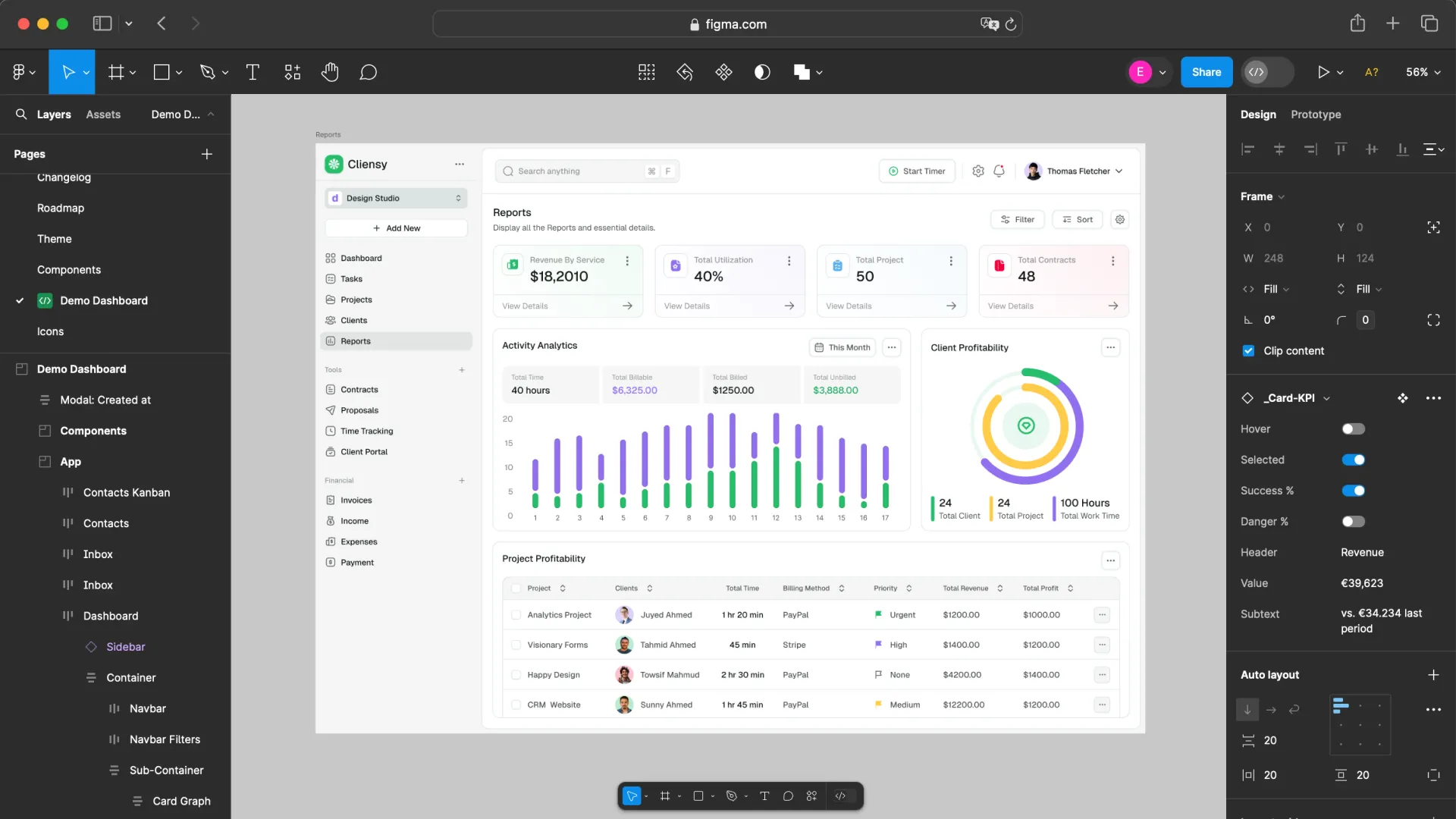
Designers develop a design that's responsive to different devices, create a logical visual layout for blocks, and ensure user-friendliness - managers must quickly navigate booking statuses, tour availability, payments, and customer communications. The interface must be simple, modern, and intuitive for all users, consistent with the overall brand's visual identity.
Programming and integration
At this stage, developers write code for the backend, creating the business logic of the tourism CRM and setting up the database. An API is implemented for processing requests, managing bookings, and ensuring secure data storage. At the same time, the frontend is developed, providing a user-friendly interface for travel agency managers and clients. Integrations with external services, such as booking systems, mapping platforms, payment gateways, and email newsletters, are also configured.
Testing and bug fixing
Testing includes load testing (resilience to a large number of requests), functionality in various booking scenarios, taking into account various user errors, and UX/UI. Programmers fix bugs and improve system performance.
Release and implementation
The final stage involves configuring the server environment, deploying the CRM on the hosting platform, and testing it in real-world conditions. Following the release, the travel agency will gradually transition to the new CRM to ensure uninterrupted operations. Each employee should receive clear instructions on how to use the new system and prompt assistance in resolving issues.
System support and development
In the tourism industry, rapid response to changes in legislation, tour operator requirements, and customer preferences is critical. Technical support after CRM development is essential for fixing errors and adding new features, updating security systems, and increasing system capacity as business volumes grow.
Why you should order a CRM for your tourism business from AvadaCRM
Are you looking to manage your tourism business effectively? Customers now expect personalized service and instant responses, so investing in automation is the right decision. AvadaCRM is your reliable partner for software solutions for the tourism industry.
We offer teams of specialists with extensive experience in developing CRM systems for travel agencies and handle all stages of development, from business process analysis to post-launch system support.


FAQ
-
Is it possible to integrate a travel agency's CRM with a website?
The CRM can be integrated with the website to automatically receive requests and display current tours and bookings in real time. This significantly simplifies the work of managers and improves the user experience.
-
Does the CRM system for tourism support automatic mailing to clients?
Yes, the system can automatically send email, SMS, or instant messaging messages with reminders, promotions, booking statuses, or personalized offers.
-
How does this help avoid duplicate bookings?
The travel agency CRM system features an updated centralized database and mechanisms to prevent duplicate requests. This reduces the risk of errors and double bookings.
-
Is it possible to set up access levels for employees?
The management system allows you to set different access levels for administrators, managers, accountants, etc. This allows you to protect data and ensure control over work processes.
-
What reports can be obtained in the CRM system for a travel agency?
A tourism CRM system allows you to generate reports on sales, advertising effectiveness, destination popularity, customer behavior, and manager performance.
-
How does this make working with tour providers easier?
The system allows you to save supplier contacts, automate interactions, update prices, monitor payments, and maintain a history of cooperation.
-
Is integration with payment systems possible?
CRM can be connected to various payment systems to automate payment acceptance, invoicing, and financial transaction accounting.
-
Does a small travel agency with limited staff need a CRM system?
A customized CRM is essential for travel agencies of any size. At a minimum, it will help manage your client base, streamline communication, and avoid errors. This is especially useful when your team is small and each person is juggling multiple responsibilities.
-
How long does it take to develop a CRM system for a travel agency?
The development and implementation timeline depends on the number of processes and the depth of customization, but typically takes 3-4 months. Multiple features can be implemented, but you choose what you need at the current stage, without overloading the program with unnecessary features.